Showing posts with label 19th century. Show all posts

New Museum Website!

Posted by Unknown

Sorry, this is taking the place of your usually-scheduled fashion plate. There is a new museum (partial) collection out there, available for your perusal! In the main, it consists of scans of photographs, especially ones of the Adirondacks taken by Seneca Ray Stoddard around the end of the 19th century, street scenes in Glens Falls, NY, and portraits of citizens of that town.

Caroline Agnes Ranger, 1887; CHM 1996.58.23
And I know about it because my job for the past couple of months has been to clean up the files and get the database ready for uploading. It's been a wonderful change from office work, believe me. I've gotten to know a lot of Victorian Adirondack hotels, and done a ton of genealogical research for the people files.

The benefit of having me do it is that whenever a photo is of interest to people looking for historical fashion details, it's been tagged with "Clothing & Dress" in the search terms. Check it out! I've made sure that there are even Pinterest buttons on each file, to facilitate pinning.

Friends in Council, ca. 1899; CHM 1980.77.2
At the moment, there are no objects from the collection in the online database, but that will change. On Monday I began to photograph a few smaller objects that would fit in the picture-taking area, and I hope to be able to dress some of the wedding dresses on mannequins before I leave. The Chapman has a fantastic costume collection for such a small, upstate institution, and the world needs to see it.

As you read this, I will be on the bus to New York City for a big interview. I may or may not be panicking.
More about → New Museum Website!

Godey's London Fashions for May, 1834: Morning Dresses

Posted by Unknown

[NB:  I typed this one about a year ago, when I was doing those posts based on my plate-less 1834 Godey's - putting together what the different aspects of the dress the text is describing so you can get an idea of what the original plate would look like. Somehow I never got around to posting this last one.]

MAKE AND MATERIAL OF MORNING DRESSES. - This is the first time since Christmas that any change has been perceptible in the redingote; cloaks have almost disappeared; the lingering symptoms only of winter is a large shawl thrown over the morning dress, and on bleak days a muff.  There is quite a new fancy for the front of the dress; a bias trimming, like a V reversed, finished at the corners with a blue bow of ribbon or an acorn.  Walking dresses should be made of the simplest form: the materials now worn are in themselves sufficiently rich for demi-neglige: - there is a style of dress beyond expression elegant. - The corsage quite flat, and buttoned with gold buttons down the front; the skirt of a moderate width, (hail to that word!) the sleeves large and unadorned; the chief difference at the present moment between morning dresses and such as are worn at operas, or our theatres, consists in the shade of colour rather than the material or make.  Redingotes of muslin, lined with colored sarsenet, are now frequently adopted as habits de reception; they are tied down the fronts with bows of the lace satin ribbon.

PREVAILING COLORS FOR MAY. - Citron, jonquil, lilac, vert de Paradis, pale blue, and rose color.


This is the first time since Christmas that any change has been perceptible in the redingote; cloaks have almost disappeared; the lingering symptoms only of winter is a large shawl thrown over the morning dress, and on bleak days a muff.  
I think what is meant by the first segment is that redingotes are finally getting lighter.  As in the eighteenth century, a redingote is a long-sleeved gown; it seems to count as "half-dress", used for walking and riding, but it can also be opera dress, which is very formal.  The material seems to be more important than the form when it comes to the level of formality, muslin and lace for morning, satin for the opera.  The references I can find generally mention that they are worn open in the skirt (and sometimes also bodice) over a petticoat or another gown.  At the same time, "pelisse" was still in use, so there are probably some more criteria that separate the two garments: perhaps the pelisse was seen as a coat put on over a dress, while a redingote was worn over an underdress that was only meant to be worn under another gown, or just a petticoat.  Redingote may also be used interchangeably with peignoir during this period.

Carriage dress, November 1831, La Belle Assemblée - probably a redingote

Modes de Paris, Petit Courrier des Dames, December 1838 - left is a shawl over morning dress, right is technically a paletot, not a redingote, but it's similar in form, and there's a muff involved

There is quite a new fancy for the front of the dress; a bias trimming, like a V reversed, finished at the corners with a blue bow of ribbon or an acorn.  
At the moment, I can't find anything to illustrate this.  It's a strange trim pattern, as it would actually widen the waistline, which is probably why it doesn't turn up in the fashion plates or in paintings.
Walking dresses should be made of the simplest form: the materials now worn are in themselves sufficiently rich for demi-neglige: - there is a style of dress beyond expression elegant. - The corsage quite flat, and buttoned with gold buttons down the front; the skirt of a moderate width, (hail to that word!) the sleeves large and unadorned; the chief difference at the present moment between morning dresses and such as are worn at operas, or our theatres, consists in the shade of colour rather than the material or make.
I find that last bit very interesting, as there's a general line of thought that formality increases as the skin on view increases, and as the expense of the fabric increases.  And while this is just one article contradicting that, the multiple citations I found for redingotes - satin redingotes for the opera, muslin redingotes for morning, silk redingotes for riding - does imply that the rule of expense and skin doesn't apply across the board.  Definitely worth thinking about for this period.

And as to the description:
Lady's Magazine, July 1834

Redingotes of muslin, lined with colored sarsenet, are now frequently adopted as habits de reception; they are tied down the fronts with bows of the lace satin ribbon.
(See the images directly above and below - above for white cotton, below for bows in the front.)
PREVAILING COLORS FOR MAY. - Citron, jonquil, lilac, vert de Paradis, pale blue, and rose color.

Opera dress of "citron-coloured satin", La Belle Assemblée, 1834
Opera dress of "Smyrna gauze of a bright jonquil colour", The Ladies' Museum, 1830
Walking dress of "lilac gros de Naples", La Belle Assemblée, 1834
Pelisse robe of "pale blue tigrine" over a morning dress of Indian jaconet muslin, La Belle Assemblée, 1834
Bonnet of "rose du Parnasse gros des Indes", The Ladies' Museum, 1830
 ("Vert de paradis", is defined in the Merriam-Webster dictionary as Hibernian green, "a dark yellowish green that is yellower and paler than holly green, lighter and stronger than deep chrome green, and yellower, lighter, and stronger than average hunter green".  Paradise green shows up as one color on art-paints.com and another in the Pantone scale.  The term didn't come up when I searched Google Books.)
More about → Godey's London Fashions for May, 1834: Morning Dresses

Day Dress, ca. 1840

Posted by Unknown

I have had this dress in the works for a very long time. One time when I was in Walmart for ... buttons, I think, I came across this gold/brown quilting cotton with a very small leaf and floral print for $2 or $3/yard. I bought several yards of it, and set it aside until I had a reason to make an early Victorian dress.

Finally, after four or five years with not many Victorian events, I decided just to start it and wait for something to turn up. And something did! The Empire State Costumers decided to go to the Troy Victorian Stroll again (last year I went in mufti as I needed to leave fairly soon to attend Linda Baumgarten's talk on quilts at the Albany Institute), and I finished it ... a little too quickly, and there are problems, but as I always do things wrong the first time I'm just sort of glad I have the rough draft out of the way and can redo the bodice.

The leaders of the ESC trimming a tree.
Early Victorian is officially my favorite period, because it's the only one with a hairstyle that I can do. Literally the only one.

I started out with the sleeves, leaving them unlined as the originals I've seen have a very thin printed fabric with a sturdy lining, and this fabric stands up fairly well on its own. (There's an in-progress picture somewhere but I can't seem to find it.) You can't see in these photos, but the upper arm is pleated down and held with two rows of chain stitches in green DMC cotton. The bottom of the sleeve should be partially done in the same way, but due to time constraints I just pleated them into the cuff and resolved to come back later. (See example.)

When I finally gave in and decided to just make the dress already, with a pattern I'd taken at the Albany Institute, it was going to be quick and dirty. So I did the whole skirt on the machine, with some shoddy piecing and even a little "darning" near the hem, although I did also cartridge pleat it to the waistband and eventually hem it by hand. The bodice I did entirely by hand, because I didn't really start it until I moved into a place where I couldn't set up my machine. But I really think I'm faster when hand-sewing, for the most part, anyway, and very few seams really need the strength of a lock-stitch. But despite my historical authenticity, it ended up 2" too big, as do literally all of my rough drafts. Why is that?

That is a Tiffany window behind us, as they're proud to tell you.
You can see that I made a little drawstring bag to carry my phone, etc. around in. In addition to that, I've got on a grey wool Banana Republic cape I got secondhand for $60, my tan leather gloves, Fugawee Annas, and a relatively accurate bonnet of my own making. (It has issues but is a pretty color.) Overall, I was not as prettily turned out as I have been at other times, but I did feel very Victorian!
More about → Day Dress, ca. 1840

Latest Patterning Visit

Posted by Unknown

This was perhaps my penultimate patterning trip for the first book I intend to put out.  (The last one I have planned will be on the 28th, but I suppose it's possible that I could come across another venue and make another afterward.)  Yesterday I drove down to Historic Cherry Hill to take the pattern of a pretty pink silk spencer, ca. 1795, and to re-examine the petticoat of a gown I'd patterned before, as I didn't have the shaping of the top quite right.  This pattern may be one of my favorites - I like seeing the differences between similarly-cut gowns and sacques, but it's really nice to take the pattern of something very unlike what's come before, not to mention unlike what's in previously-published books.

It has an adorable peplum.

Afterward, I went to the Schenectady County Historical Society museum in the lovely stockade district to see Underlying Structures: What Shaped the Victorian Woman?  The exhibition shows a wonderful array of later Victorian dresses and accessories.


I highly recommend you take a trip over to the museum, if you live nearby.  Costume exhibitions are not common outside of the big cities, and it's good to support local historical societies!

Edit: 400th post!
More about → Latest Patterning Visit

New Collection Online!

Posted by Unknown

At the moment my mild-mannered alter ego is a receptionist in a doctor's office, and we are required to show YNN Capital Region all day long.  Yes.  Much of the time it is ignorable, frequently it is appalling, and occasionally it tosses up something of interest.

Today, that little gem was a spot on the Albany Institute of History and Art!  It was lovely to see the inside of the vault and the collections again, and it was especially nice to see Tammis Groft, the chief curator.  But part of the point of the spot was that they've created an online collections database, which is the sort of thing we all love to see.  Now I can link you directly to Ariantje Coeymans, one of my favorite portraits out there.

"Ariantje Coeymans", Nehemiah Partridge, ca. 1720; AIHA 1938.5


You can also see whole categories of objects, such as (of course) Textiles, Costume, and Accessories.  The whole collection isn't represented, not by a long shot - but what's there is gorgeously photographed.  Shoes and jewelry seem to make up the bulk of that category; the gowns listed were photographed a while ago for the physical catalogue.  But we can hope that more will show up as time goes on, because, let me tell you, there are some amazing pieces there.

"Nathan Hawley and Family Nov. 3d, 1801", William Wilkie, 1801; AIHA 1951.58


More about → New Collection Online!

Tea in Kinderhook

Posted by Unknown

On Saturday, I went to the Formally Invited tea at the Vanderpoel House in Kinderhook, put on by the Columbia County Historical Society and Clermont State Historic Site.  It was wonderful!  The whole first floor was cleared, with one room for the tea, punch, and food, one room for coats (and a full-length mirror, so you can make sure your outfit is all right), and the doors between the parlors opened to create one long space for dancing.


The food was fantastic - butter cookies, seed cakes, a pound cake with currants, salmagundi, syllabub (first time I ever had syllabub), strawberry ices, and these little chicken tart things - and there was a whole selection of teas, including the custom Vanderpoel and Clermont blends, which were the two I tried.


My favorite part of the afternoon, apart from getting to talk to so many other enthusiasts, was learning to dance.  Sadly, I can't remember the names of the two dances I learned, but I did learn two!  I could probably even do them again.  I definitely recognized them from P&P95, which was very cool.  I DO ELIZABETH BENNET DANCES.  After that I went to cool down with some champagne punch (movies don't always give the impression that country dancing was a very energetic pastime, but it so is), and spent the rest of the time talking about sewing and museums and the Lizzie Bennet Diaries.


 My face is good in this one so it gets to be bigger.
Me with Kjirsten from Clermont

As you can see, I wore the transitional gown I made for my qualifying paper, pinned up for dancing and walking around a crowded room.  I also had on a red wool spencer I made for the Empire State Costumers' meal at the Tailored Tea in Latham.  I'm not super happy with it; I draped the pattern on my Uniquely You form while looking at the riding habit in Patterns of Fashion I and it fit the dress form very well, but my bust in the light transitional corset is very different from my dress form's bust and I had a hard time with the darts.  The back and the peplum are cuter.  I made my bonnet for a planned ca. 1840 outfit, so it doesn't technically fit this one, but I don't think it looks glaringly wrong.

I would really love to go to another event like this one, but I want a proper Regency ensemble.  The other night I worked out a pattern to make this adorable corset (mostly by machine, I think, because I'm just not very good at corsetry and don't want to hand-sew all of it and then have it drastically not fit), and then I would like to make this gown:

Evening dress, 1938.3.1, Albany Institute of History & Art: 200 Years of Collecting, Tammis Groft and Mary Alice McKay, 1998, p. 279
Because of its inclusion in the catalogue, it was decided that this wouldn't be in the Great, Strange, and Rarely Seen exhibition, but I took the pattern anyway (before the dress-theme was changed to the 1920s at the last minute, I was hoping to put patterns of all the gowns on the museum's website).  It belonged to Ann Eliza Ten Eyck (1804-1866), a member of a long-standing Albany family, who was said to have worn it to a ball given in Lafayette's honor at Clermont (FULL CIRCLE) in 1824.
More about → Tea in Kinderhook

Coiffures of Godey's 1864

Posted by Unknown

Last weekend I gave you the January fashion plates from my bound 1875 Godey's - this Saturday, in honor of My Vintage Visions's trip to Gettysburg, as she was looking at hairstyles, I thought I'd share the hair pages from my 1864 Godey's, all through the year.

Fig. 1 - Spring coiffure for a young lady.  The hair is waved, brushed over frizettes, and caught into a puff by a fancy side comb.  The back hair is dressed waterfall style.

Fig. 2 - Fancy evening coiffure.  The hair is arranged over a cushion in front, and a large bow falls low on the neck at the back.  A bouquet of flowers is placed directly over the forehead.

The front hair is divided in three parts, and arranged loosely over frizettes.  The back hair is twined and caught up in two loose loops.  This is one of the newest spring styles.


Fig. 5 - The Clarissa coiffure.  The hair is rolled off the face in front, and the ends braided.  The back hair is arranged in a large bow, very low on the neck, and covered with a net.  The ornaments are peacock feathers.

Fig. 6 - The Merny headdress.  The hair is rolled over a cushion in front, and arranged in a waterfall at the back, round which is twisted a heavy plait.  The comb is of black velvet and gilt.  The coiffure is composed of a black barbe and lilies of the valley.

Fig. 1 - Headdress of white plumes, the hair rolled up to one side of the head, the ends allowed to hang in curls, the curls fastened by a jewelled ornament.  The back hair rolled up and fastened by an ornamented comb, which can be seen from the front.

Fig. 2 - Headdress of pink roses and leaves, arranged in a large bouquet in front; in the back so arranged as to appear to catch the delicate lace coiffure and keep it in its place.  The back hair arranged in puffs; the upper part of the front rolled back, the under part curls and allowed to hang down.

Fig. 1 - Coiffure for a married lady.  The front hair is in double rolls, and the back in three long double loops.  The headdress is of point lace, roses, and fancy flowers.

Fig. 2 - Headdress of corn flowers and wheat-ears, arranged in three bouquets.  The hair rolled off the face on top of head on cushions; at the side, on puffs.  The back hair arranged in waterfall style.

Fig. 1 - Evening coiffure for a young lady.  The front hair is arranged over cushions, and the back hair in the waterfall style, with one long curl falling over the shoulder.  The ornaments are peacock plumes.

Fig. 2 - A Grecian coiffure for a young lady.  The ornaments are white and peacock's plumes, with a fancy comb.

Fig. 3 - Ball coiffure.  The coronet is formed of black lace and brilliant colored flowers of the Scotch style.  The streamers are of scarlet and green velvet ribbons.  The hair is rolled from the face, and arranged in waterfall style at the back.
More about → Coiffures of Godey's 1864

Fashion vs. Feminism

Posted by Unknown

AuntieNan left a comment on my Godey's post that I started to answer, but realized it was going to be long enough (and could do with illustrations) that it'd be better served as a full post.
I had a costume history teacher who talked about the development of feminism and how a burst of power for women was usually followed by a period of excessively feminine line for women--the long Victorian period that came after Mary Wollstonecraft, the 1950s after the flappers and freedom during the big wars. She also said that in times of feminist freedom, fashion played down the more assertive lines of a woman's figure--that a woman could only take the reins if she looked as much like an androgynous creature as possible. I don't know if that's true, or accepted thinking, but she sure had some good examples to back her up!!

I remember coming across this in The Beauty Myth, and at the time it seemed to make a lot of sense to me, but I've since done a lot of studying (staring at fashion plates) (and Pinterest, can't forget that, I have over 5k pins right now) and learned more specifics, and fashion now seems too complicated to sum up in that way.  The trouble with trying to pinpoint reasons for changes in dress is that they're so rarely abrupt.  In my fashion mythbusters symposium/class, we watched several episodes of a cable tv show that was meant to show the history of the little black dress, makeup, high heels, etc. but failed, mainly as a result of its constant use of single events/films/people to drive history.

If you look at fashion plates in order from 1800 to 1840, it makes sense for dress to go the way it did - for the waist to drop and tighten, for the skirts to bell out - because all the changes are so gradual.  Fashion is always looking for something new (while also always looking back to the past), so the high waist had to boomerang back to a low waist, puffed sleeves had to flatten out to fitted ones, narrow skirts had to flare out and then get fuller.

(Journal des Dames et des Modes: 1803, NYPL 801884; 1807, NYPL 801737)

 (Journal des Dames et des Modes, 1815, NYPL 801885; 1818, NYPL 801894)

 (Petit Courrier des Dames, 1822, NYPL 802051; Journal des Dames et des Modes, 1828; NYPL 824326)

 (Petit Courrier des Dames, 1834; NYPL 802137; unknown periodical, 1837, CCDL FPC 199)

Going directly from the top row to the bottom one shows a huge jump, but it's little steps all along the way - and slow enough that it's difficult for me to believe that it was a reaction to any single thing.  At the same time, the 1790s/1800s are hard to characterize in terms of modern feminism.  There were literary, educated women through the eighteenth century who advocated for women's education, but they didn't have a huge impact on society.  Rousseau's theories on child-rearing, innocence, nature, etc. were more widely influential, and are considered today as modern and appropriate, yet they paved the way for the cult of motherhood of the nineteenth century that's seen as going hand-in-hand with the "dowdy", "repressed" fashions of the late 1830s and the 1840s.

Tailor-made and street gown, The Peterson Magazine, January 1891; NYPL 815737
Throughout the Victorian era, there were feminists continuing to champion women's rights and sometimes win battles (both the US and the UK had various Married Women's Rights Acts that gave women a chance for custody, ownership of money and property, etc. and divorce became more common and simpler), but it's hard to show that women's fashions grew more feminine in response.  In fact, the influence of menswear in women's dress increased, with suit and cravat effects and "tailormades".  But in the first place, when comparing Regency fashions to those of the early Victorians, how can one decide which is more restrictive or feminine?  1800s/1810s fashion wasn't androgynous - although the hourglass figure wasn't popular then, the bust was prominently raised and the body's shape was comparatively apparent through light gowns, making the "long stay" a necessity for women who weren't slender.

"Portrait of a Lady", James Ramsay, ca. 1810; Newstead Abbey NA 497
It's really hard to define "periods of feminist freedom". The 1920s are thought of as such because we value the moral liberation side of feminism the most when we talk about history (that's my impression, anyway) and women were definitely liberated in terms of behavior in comparison to earlier decades, and in America and the UK the right to vote had just been won - but in other aspects, there's not much difference from before.  There was still unequal pay, women were still only employed in a few specific and limited positions, marriage was still often a bar to work outside the home, all that sort of thing. At the same time, I question the popularly-thought-of androgyny of the 1920s.  While fashion plates do show short-haired, thin women (which go from ordinary-thin in the early '20s to caricature-thin in the middle of the decade, and then get broader in the shoulder towards the end), high-heeled shoes, skirts of varying lengths, embroidery and beading, floral patterns, lace, and pastel colors all contribute to a highly feminine look.  The faces on these fashion plate ladies are also very cute and girlish, with well-defined bow lips.

Evening dress design, Jules de Ban (for Lucile), 1924; VAM E.2940-1962

And then - sorry, my last point - there are the designers and fashion icons that affected fashions the most.  Their individual motivations were perhaps the most relevant to what styles were successful; in the case of the latter, looking splendid and beautiful was the goal.  For both, constant change to remain ahead of the following masses was hugely important, as well as personal taste.  Many male couturiers are known to have designed clothing that would suit their wives (such as Paul Poiret, who helped to create the slender 1910s and '20s line).

"Empress Eugenie", Franz Xaver Winterhalter, ca. 1860; location unknown
(Read more about a few female fashion leaders in my post on Queen Victoria and fashion, here.)

To conclude, I'd have to say that I do think there's social pushback when women advance and push the envelope, but I don't think it was/is imposed through clothing.  There are too many factors influencing fashion - popular fiction (see Dolly Varden), designers' tastes, nostalgia, art history, theatrical roles, archaeological discoveries - and far too many women in too many different situations and countries that would have to collude in reacting that way.  One of the constant debates in fashion history is what effect non-couturier men have in women's dress - many have stated that women wore corsets and various skirt supports to attract men, or other "because of men" reasons, but it's becoming more popular to see clothing as a tool used by women for other means.  The New Look was incredibly popular with women who wanted that luxurious, hyper-feminine style after the fabric rationing of the war.  Dior (and the other designers doing the same thing at that time) were only picking up where fashion had been heading before WWII - toward a more hourglass figure and fuller skirts.  Women's fashion is first and foremost something that women put on themselves, and while patriarchal pressure can affect what women feel is acceptable to wear, there is also a large element of choice.  Some women feel empowered when taking on masculine aspects in dress, and others feel empowered when emphasizing an hourglass figure, probably depending on what flatters the individual.  I know that corsetless and in a tubular ca. 1926 evening dress I would be horribly self-conscious and uncomfortable!
More about → Fashion vs. Feminism

Godey's, January 1875 - Fashion Plates

Posted by Unknown

Recently I've been spending ... probably too much time on eBay, and I've found that while the listed Buy It Now prices for hard-bound full or half year runs of antique ladies' magazines are ridiculously high (I saw one listed at about $1,000), when the market can set its own prices in auctions, they are much more affordable.  So now I have some treats!


Description of Steel Fashion Plate

Fig. 1 - House dress of black silk, made with one skirt.  The side breadths are trimmed with kilt plaiting from the waist, with bands of silk crossing them, bound with silk of the new cardinal red; puff in the back of the skirt; jacket bodice, trimmed to correspond; open sleeves, with puffs on top.

Fig. 2 - House dress, made of two shades of green silk.  The underskirt is trimmed with narrow ruffles; the polonaise fastens over at one side, and is trimmed with a ruffle and band; the neck is cut surplice; open sleeves, at top of arm.

Fig. 3 - Evening dress of pink and white silk, made court train.  The front breadth is formed of apron and ruffle of white silk embroidered, trimmed with wreaths of foliage laid in ruches of lace; low corsage, with bertha to correspond.

Fig. 4 - Dinner dress of two shades of purple and lilac silk.  The underskirt is of the darkest silk, trimmed with one ruffle, piped with the lighter at both top and bottom; three narrow folds head it at the top; apron overskirt of the lighter silk, with two box-plaited ruches for trimming; long pointed basque waist of the darker silk, cur surplice; coat sleeves, trimmed to correspond.  Sash in the back.

Fig. 5 - Walking dress of two shades of brown silk.  The underskirt is of the two shades of silk, the ruffles and plaitings being of the lighter; the jacket waist is deep on the sides and front, and is trimmed with the lighter silk; coat sleeves, with cuffs.  Bonnet of the two shades of velvet, trimmed with a long feather.

Fig. 6 - Dress for a child of four years.  Dark blue silk poplin dress and cloak, trimmed with Duchesse lace.  Blue velvet hat, trimmed with white and blue feather.

Description of the Extension Sheet, Second Side (first side and earlier parts of second are missing)

Fig. 24 & 25 - Girl's cross-over fichu and tablier.  This style of garment, made in woollen materials, will be much worn by girls from seven to fourteen years of age.  Our model is made of blue serge flannel, and is trimmed with a blue woollen fringe, with a fancy heading streaked with color.  The tablier is draped at the sides, sewn to a waistband, and fastens at the back.  The fichu crosses over the chest, and at the end turns back with a revers.

Fig. 26 - Black velvet bodice, trimmed with blue jet ornaments and feather trimming.


Figs. 27 & 28 -  Front and back view of dark blue cloth dress, braided, for child of three years.

Figs. 29 & 30 - Front and back view of dress for girl eight years of age, made of brown diagonal serge.  The underskirt is trimmed with two ruffs; the overskirt and jacket bodice is trimmed with narrow piping folds.

Fig. 31 - Fashionable kid boot, buttoned, and stitched up with white.

Fig. 32 - Evening coiffure, composed of braids and puffs, with a bow of ribbon and a rose at the right side.


Figs. 33 & 34 - Front and back view of black velvet sleeveless polonaise, embroidered with jet and silk, and trimmed with lace.

More about → Godey's, January 1875 - Fashion Plates

Bonnetry

Posted by Unknown

(I did most of this entry about a month ago, so it makes reference to Things Happening and I'm just noting that they happened several weeks ago, not recently.)

At work I've moved completely into Putting Numbers On Things.  This is in two categories: Finding Things' Original Numbers, and Giving Things New Numbers.  The former is preferable, because it means you have some provenance and can prove the museum owns it, which is very important if you want to deaccession an item, but it can be pretty difficult, so I've been doing a lot of the latter.

One of the objects I gave a new number to on Friday was a bonnet quite like the Allie model in Mrs. Parker's Millinery and Mercantile.  (Quite, quite like - the milliner says it's based off one in her collection, and there's another one that's almost identical to it at the Chapman, so that's interesting.)  Since I was looking it over for any kind of number I noticed that it was in pretty bad shape, allowing you to see its inner workings, so of course I took out my camera.  And then I looked in on a couple of the other bonnets to snap some shots there as well, just because.


The back, with the bow and the curtain.  Those two lines on the curtain are ironed-down pleats, like tucks but not sewn.  If you zoom in closer, you can see that the taffeta is positioned to be on the bias across the back.  The vertical pleats on the back aren't very deep.


The bias-cut curtain is flatlined - after the tuck-pleating - with a very large gauge bobbinet.  The hem is folded up and sewn only to the bobbinet, not through all the layers.


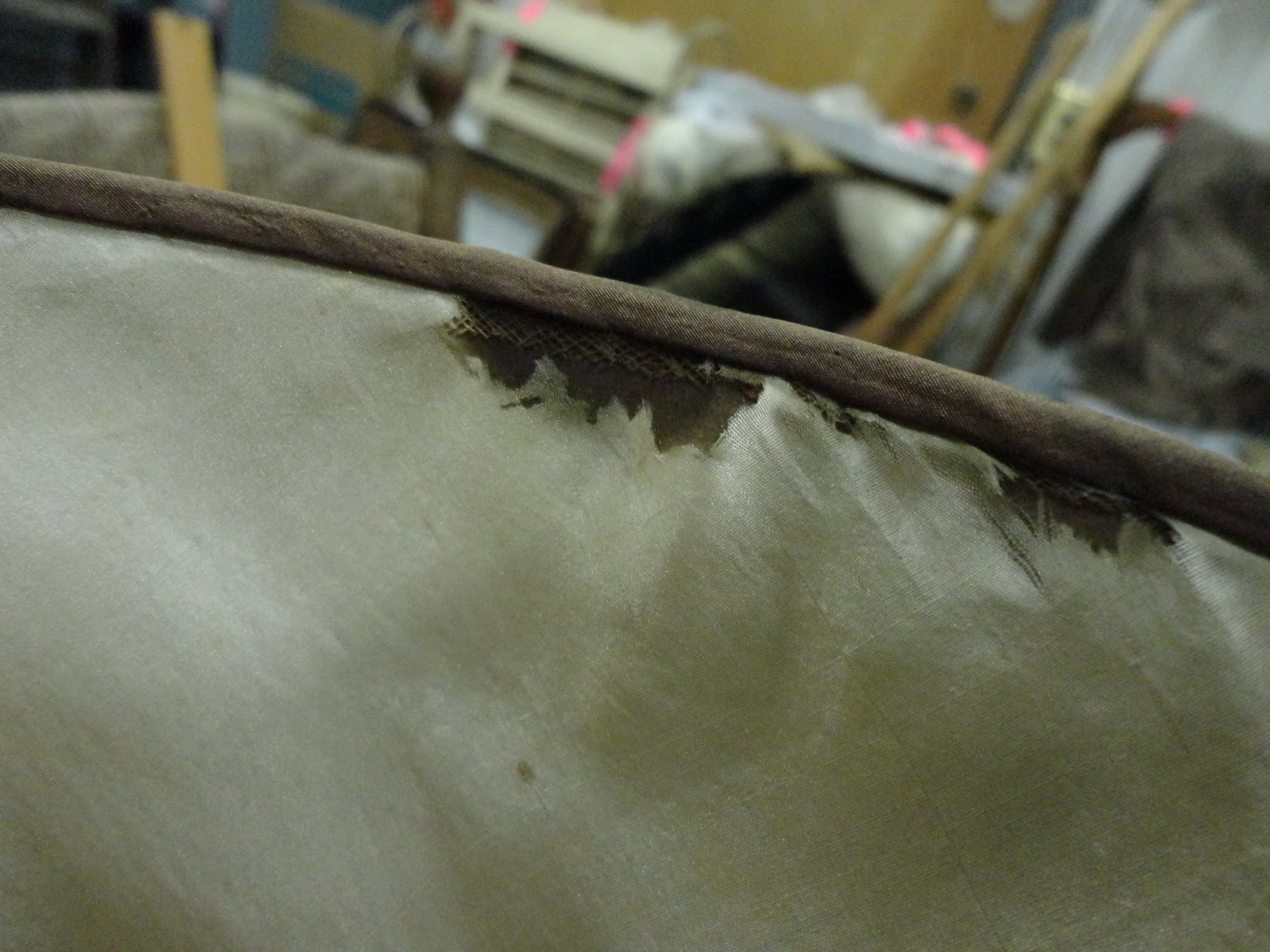
The off-white taffeta lining is coming apart, so you can see what's underneath.  A wire runs all the way around the front edge to help control the shape, sewn to the paper interlining (which has kind of crumbled around here). These white running stitches would be hidden under the lining; I think they'd be pulled to gather the green taffeta just slightly enough to make it taut over the interlining.  I think the thread is cotton.


Close-up of where the brim attaches to the crown.  The crown is a very light buckram, pleated to shape, not covered.


The interior of the crown: buckram, cut and pleated to fit.  I don't believe it was ever covered.  It's smooth enough that hair wouldn't get caught in it, and it wasn't going to show.


The visible part of the brim here is the paper interlining - about as heavy as file folder material, I'd say.  There are a lot of stitches holding the crown in shape, the brim's stitched right to it, and none of the stitches are neat.  They don't need to be!


While the off-white taffeta lining covers a lot of the exciting stitching going on in the structural levels, the ribbon ties are attached with big, serious whipstitches.

And a different bonnet, same vintage:


The two have essentially the same brim shape.  This one is bias-bound around the face edge, probably to cover that structural stitching.  And the ribbon ties - very, very similar in color to the previous - are sewn tucked into the band that runs over the top of the bonnet, and under the edge of the curtain.


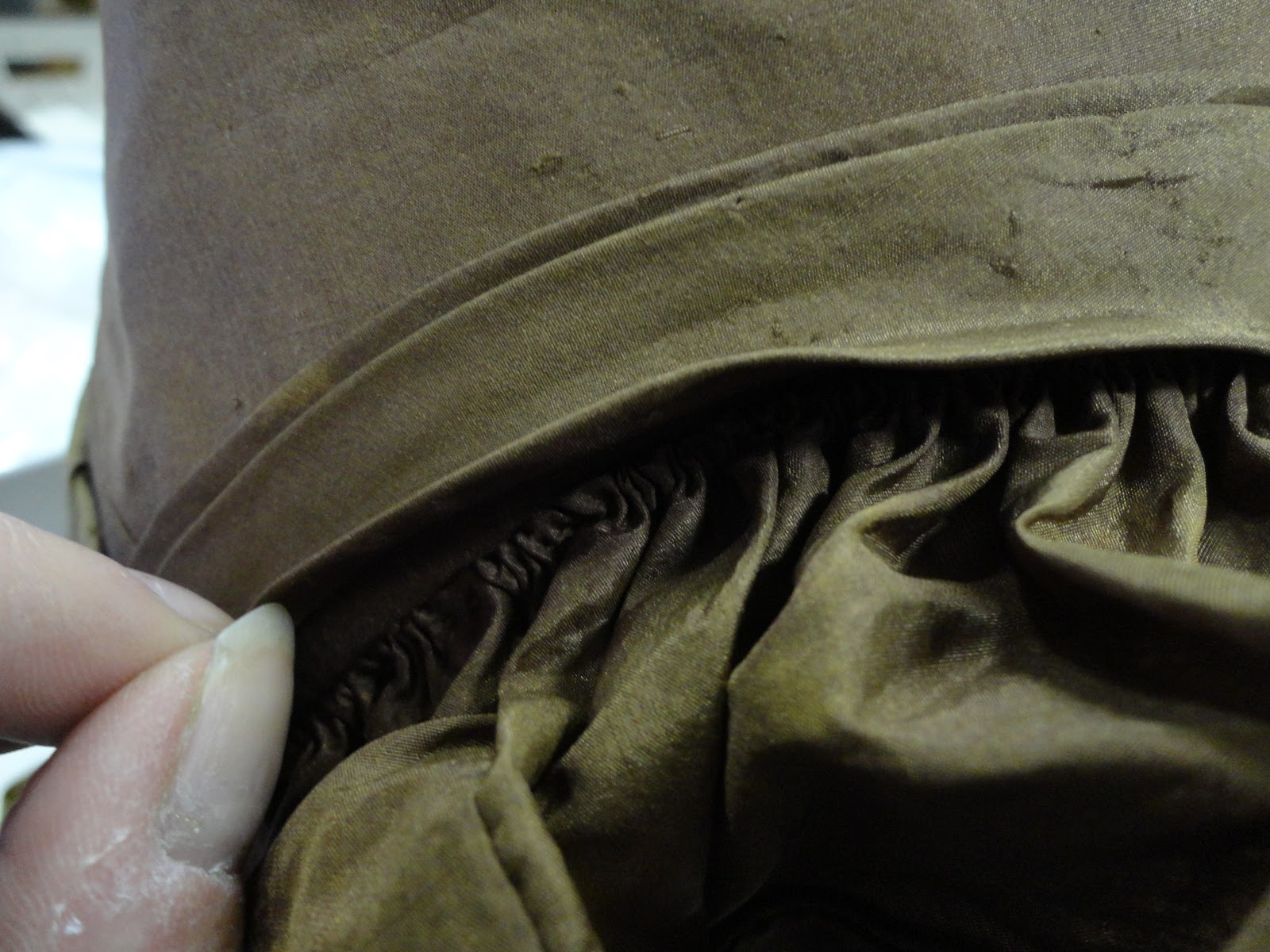
This bonnet was more interesting on the outside.  Very thick piping surrounds the back of the crown, and a pleated self-fabric band covers the curtain attachment.


See, you can peek at the gathers underneath.  (Eesh, my hands are really dry.)


The bottom of this curtain ruffle is actually piped, which gives it more body and matches the crown piping.


The attachment of the ribbon and the curtain to the brim.


Full interior shot.  There's a piece of bias-cut gauze tacked over the brim attachment, and I think that that's the only lining that would have been inside the crown.  This bonnet has a crown made in two pieces rather than a pleated one.


The hook and eye would hold the ribbon closed beneath the bow, which sounds like a really good idea to me.


The very edge of the brim.  This lining is in much better shape, so this is the only place you can see the paper/board interlining, the same as in the last one. 
More about → Bonnetry