Showing posts with label photos. Show all posts

Day Dress, ca. 1840

Posted by Unknown

I have had this dress in the works for a very long time. One time when I was in Walmart for ... buttons, I think, I came across this gold/brown quilting cotton with a very small leaf and floral print for $2 or $3/yard. I bought several yards of it, and set it aside until I had a reason to make an early Victorian dress.

Finally, after four or five years with not many Victorian events, I decided just to start it and wait for something to turn up. And something did! The Empire State Costumers decided to go to the Troy Victorian Stroll again (last year I went in mufti as I needed to leave fairly soon to attend Linda Baumgarten's talk on quilts at the Albany Institute), and I finished it ... a little too quickly, and there are problems, but as I always do things wrong the first time I'm just sort of glad I have the rough draft out of the way and can redo the bodice.

The leaders of the ESC trimming a tree.
Early Victorian is officially my favorite period, because it's the only one with a hairstyle that I can do. Literally the only one.

I started out with the sleeves, leaving them unlined as the originals I've seen have a very thin printed fabric with a sturdy lining, and this fabric stands up fairly well on its own. (There's an in-progress picture somewhere but I can't seem to find it.) You can't see in these photos, but the upper arm is pleated down and held with two rows of chain stitches in green DMC cotton. The bottom of the sleeve should be partially done in the same way, but due to time constraints I just pleated them into the cuff and resolved to come back later. (See example.)

When I finally gave in and decided to just make the dress already, with a pattern I'd taken at the Albany Institute, it was going to be quick and dirty. So I did the whole skirt on the machine, with some shoddy piecing and even a little "darning" near the hem, although I did also cartridge pleat it to the waistband and eventually hem it by hand. The bodice I did entirely by hand, because I didn't really start it until I moved into a place where I couldn't set up my machine. But I really think I'm faster when hand-sewing, for the most part, anyway, and very few seams really need the strength of a lock-stitch. But despite my historical authenticity, it ended up 2" too big, as do literally all of my rough drafts. Why is that?

That is a Tiffany window behind us, as they're proud to tell you.
You can see that I made a little drawstring bag to carry my phone, etc. around in. In addition to that, I've got on a grey wool Banana Republic cape I got secondhand for $60, my tan leather gloves, Fugawee Annas, and a relatively accurate bonnet of my own making. (It has issues but is a pretty color.) Overall, I was not as prettily turned out as I have been at other times, but I did feel very Victorian!
More about → Day Dress, ca. 1840

White Muslin Gown, ca. 1780

Posted by Unknown

Should have asked Mom to stand up to take the picture ...
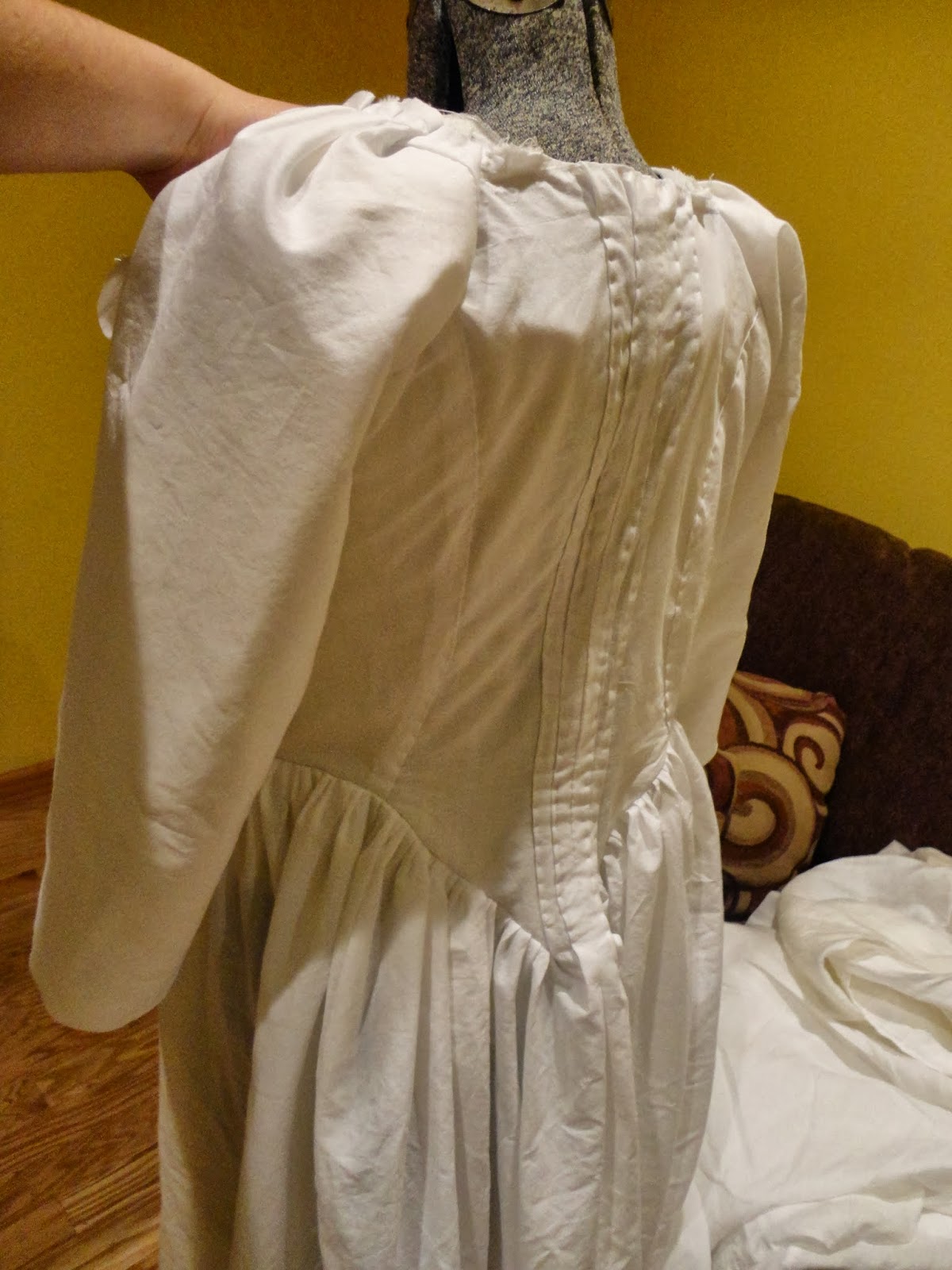
This is the first 18th century gown I've made since taking those many patterns for my book, and I think it's a great improvement over the blue linen one I made a few years ago. (The stays underneath are much better as well.)

I based this gown on the one pictured below, an anglaise with back pleats, a closed front, rounded skirt edges, and loops inside to pull it up (which I haven't put in yet but plan to eventually). It's also based in part on all the quotes about muslin gowns and silk coats, although this coat is linen.

Albany Institute of History and Art 1961.26.1a-b
The original has a matching petticoat, but the one I wore to the Battle of Saratoga re-enactment is old, from the Old Stone Fort fiasco/ensemble. I really need to repleat it and replace the waistband, but somehow that never seems very important until I put it on and realize it's too big.

What I've Learned

- When scaling up an 18th century pattern, don't widen all the pieces in equal proportion. The back pieces barely need to be enlarged. Just because the dress form's shoulders are enormous doesn't mean that I need the straps to be out that far. (But once I fiddled a bit, I ended up with one strap in the exact right place and the other only out a bit too far, which is a huge improvement on my previous efforts - it's hard for me to get rid of preconceptions about where shoulder seams are supposed to go.)

Way too wide.
- Allotting enough fabric for the pleats is very important, otherwise you end up with these tiny, tiny little pleats.


- I always have this weird thing about setting in 18th century sleeves, where I want them to be really pleated at the top. This is silly and I know it's silly because I've taken enough patterns to know that you don't need that! After taking out the pleats, I put it back on and tugged the sleeves up to fit more snugly. I could have actually cut them a little bit smaller.

No! When laid flat on a table, the sleeves should want to be out at right angles.
Anyway, there are all sorts of little problems (the waist was WAY too low at first, and I raised it wherever I could, but there's only so much you can do with this style of back), but I'm very happy with how this turned out. Can't wait until next summer's 18th century events with the ladies to take it out again!
More about → White Muslin Gown, ca. 1780

Montgomery Place Picnic

Posted by Unknown

This past Sunday, the Empire State Costumers core group met up for a Victorian picnic lunch on the grounds of Montgomery Place, at Annandale-on-Hudson. We decided not to pay for a house tour and just stay on the grounds, so I don't know very much about the house's history - but it's a Livingston property, like Clermont.

I drove down to Julie's house in plainclothes, and got dressed up there. Julie's man Dan (also dolled up!) drove us over to pick up Rebecca, and then we all went off in the sunshine, in a car stuffed as full of food and bustles as possible.

A handy docent took our picture on the front porch. (I went with an adolescent hairstyle because I am routinely taken for a teenager. And it was simple.)


Ooh, that reminds me. I forgot to post about going to the Floral Fête! There was a big to-do in Saratoga Springs this summer because it was the racetrack's 150th anniversary. To celebrate, they brought back the Floral Fête, a parade and festival that was a yearly event in the late nineteenth and early twentieth centuries. I did the math wrong and thought that 1873 was the year, and by the time I realized it was 1863 we'd already decided to go with 1873. These are the same gowns we made for the Fête.


The food was delicious. Despite my corset, I ate quite a bit of it.

We had a bit of discussion about the patterns I was planning to use here on the blog at one point, and I did decide that 1873 needed a proper hooped bustle ... but my budget and my time needed me to be quicker and make a lobster-tail. I did learn a lesson, though - even if you have a lot of reed around, don't use reed to bone a bustle, lobster-tail or otherwise. Part of the problem was that I sat on it in the car to go to Saratoga back in the summer and squished it, but it would have been flimsy either way.


I did end up using the Janet Arnold ca. 1871 pattern. I like it very much, but I would like it even more if I ever got around to making the ruffle to go around the bottom of the skirt. I didn't have the time before the Fête, and after the Fête I just kind of put it to one side to think about other things.


I didn't have too much trouble with it, except for a couple of little fitting issues. There's a bit too much fabric between my bustline and the neckline (unfortunate effect of being entirely too short-waisted); also, the opening of the bustled overskirt is very gappy and wrinkled. However, I realized after all the pictures that the problem there is just that I didn't cut the top of the overskirt with enough curve, so I may get around to fixing that one of these days! Maybe after I wash the skirt.


We had a little adventure in finding several small turtles making their way down to the pond at the bottom of the hill.


All in all, it was a very good trip. You can see some more pictures on our Facebook page, and if you happen to be anywhere near us, I hope you'll join the group and come along to one of our events!
More about → Montgomery Place Picnic

Latest Patterning Visit

Posted by Unknown

This was perhaps my penultimate patterning trip for the first book I intend to put out.  (The last one I have planned will be on the 28th, but I suppose it's possible that I could come across another venue and make another afterward.)  Yesterday I drove down to Historic Cherry Hill to take the pattern of a pretty pink silk spencer, ca. 1795, and to re-examine the petticoat of a gown I'd patterned before, as I didn't have the shaping of the top quite right.  This pattern may be one of my favorites - I like seeing the differences between similarly-cut gowns and sacques, but it's really nice to take the pattern of something very unlike what's come before, not to mention unlike what's in previously-published books.

It has an adorable peplum.

Afterward, I went to the Schenectady County Historical Society museum in the lovely stockade district to see Underlying Structures: What Shaped the Victorian Woman?  The exhibition shows a wonderful array of later Victorian dresses and accessories.


I highly recommend you take a trip over to the museum, if you live nearby.  Costume exhibitions are not common outside of the big cities, and it's good to support local historical societies!

Edit: 400th post!
More about → Latest Patterning Visit

Actual Sewing!

Posted by Unknown

So, I spent the past week engaged in making a Regency day dress for myself.  Fastest thing I've ever fully put together!  Albany's TulipFest is not really intended as a costumed event, but the Empire State Costumers (join us!) can turn any party into a dress-up party.

(I'm the second from the right.)

To start, I used the pattern I took from an evening dress in the Albany Institute's collection (combined with some Janet Arnold sleeves) and striped cotton from Renaissance Fabrics.  As usual with extant pieces, I am not quite as dainty, so I knew I would have to enlarge it.  Unfortunately, I chose to widen it from the center front, which made the straps set at the wrong angle and there were just all sorts of issues.  Think I'll definitely take another go at it, raising the waistline and fitting it better, but for now I need to move on.

l'original

Next up: I'll be doing a talk at Clermont on women's fashion in the 1920s in June, and I would really like to be dressed up for that.  My dilemma is that I can't tell if it'd be better to do a very plain ca. 1923 day dress, long and straight, with a pattern in my size - or to shatter expectations with what fashion/pattern magazines would refer to as "an afternoon dress with a bouffant skirt".  The bouffant dress would probably be more flattering to me than the straight one, but I'm concerned that it would go beyond "whoa, I didn't think the 1920s included things like that!" to "why is she wearing a '50s cocktail dress?" to an audience.  Thoughts?

 Union Hotel stereograph, ca. 1875; NYPL MFY Dennis Coll 91-F149 g91f149_025f

After that on the list: this year is the Saratoga Racetrack's 150th anniversary.  There are several military reenactment events on the official calendar, and maybe I'll visit them, but I think it would be lovely to
have an 1873 picnic at some point.  I do have a couple of 1860s patterns of my own, but nothing this late, so I'll likely use the ca. 1871 Janet Arnold pattern with the day bodice (probably including the neckline fill-in because I always seem to have a very hard time keeping chemises from showing there).  I'd love to make it out of lawn, along these lines.

Advertisement from Every Saturday, March 18, 1871; NYPL PC COSTU-Cor 818149

Of course, what does this mean?  NEW UNDERGARMENTS NEEDED.  I am a big fan of corsetry for its controversy and aesthetic appeal, but I have to admit that I really, really dislike sewing it.  Fitting is not my specialty, and in a corset the fit is the most important aspect.  I also have a bad track record for finishing corsets, although in this case the lack of straps and gussets means there is a better chance that I could Do This and move on to the bustle.
More about → Actual Sewing!

Tea in Kinderhook

Posted by Unknown

On Saturday, I went to the Formally Invited tea at the Vanderpoel House in Kinderhook, put on by the Columbia County Historical Society and Clermont State Historic Site.  It was wonderful!  The whole first floor was cleared, with one room for the tea, punch, and food, one room for coats (and a full-length mirror, so you can make sure your outfit is all right), and the doors between the parlors opened to create one long space for dancing.


The food was fantastic - butter cookies, seed cakes, a pound cake with currants, salmagundi, syllabub (first time I ever had syllabub), strawberry ices, and these little chicken tart things - and there was a whole selection of teas, including the custom Vanderpoel and Clermont blends, which were the two I tried.


My favorite part of the afternoon, apart from getting to talk to so many other enthusiasts, was learning to dance.  Sadly, I can't remember the names of the two dances I learned, but I did learn two!  I could probably even do them again.  I definitely recognized them from P&P95, which was very cool.  I DO ELIZABETH BENNET DANCES.  After that I went to cool down with some champagne punch (movies don't always give the impression that country dancing was a very energetic pastime, but it so is), and spent the rest of the time talking about sewing and museums and the Lizzie Bennet Diaries.


 My face is good in this one so it gets to be bigger.
Me with Kjirsten from Clermont

As you can see, I wore the transitional gown I made for my qualifying paper, pinned up for dancing and walking around a crowded room.  I also had on a red wool spencer I made for the Empire State Costumers' meal at the Tailored Tea in Latham.  I'm not super happy with it; I draped the pattern on my Uniquely You form while looking at the riding habit in Patterns of Fashion I and it fit the dress form very well, but my bust in the light transitional corset is very different from my dress form's bust and I had a hard time with the darts.  The back and the peplum are cuter.  I made my bonnet for a planned ca. 1840 outfit, so it doesn't technically fit this one, but I don't think it looks glaringly wrong.

I would really love to go to another event like this one, but I want a proper Regency ensemble.  The other night I worked out a pattern to make this adorable corset (mostly by machine, I think, because I'm just not very good at corsetry and don't want to hand-sew all of it and then have it drastically not fit), and then I would like to make this gown:

Evening dress, 1938.3.1, Albany Institute of History & Art: 200 Years of Collecting, Tammis Groft and Mary Alice McKay, 1998, p. 279
Because of its inclusion in the catalogue, it was decided that this wouldn't be in the Great, Strange, and Rarely Seen exhibition, but I took the pattern anyway (before the dress-theme was changed to the 1920s at the last minute, I was hoping to put patterns of all the gowns on the museum's website).  It belonged to Ann Eliza Ten Eyck (1804-1866), a member of a long-standing Albany family, who was said to have worn it to a ball given in Lafayette's honor at Clermont (FULL CIRCLE) in 1824.
More about → Tea in Kinderhook

1840s Chemise

Posted by Unknown

For once I have an actual sewing update!  More pictures and explanation on the official page, here, but I'm proud of it, so here is me in it:


Also, I look decent in the picture, which is more than enough reason to post it.

On L'art de la Lingere: I've decided that I'm going to be publishing it on Amazon rather than posting it here in installments.  Sorry!  But I will of course have a few promotional days so you can get it for free.  Right now I've finished the initial translation, and I'm revising it to make sentences make sense and to fix areas where I didn't quite understand words/phrases until they were made clear later on.  I'm hoping that one of my brilliant, wonderful French friends would volunteer to help me out with the areas (I promise, there are not that many) where I'm really stumped?  I will of course credit you.
More about → 1840s Chemise

The Planning and Research are the Best Bits

Posted by Unknown

It's been a long time since I made a post that wasn't just a translation, hasn't it?  Well, I have been doing some things.


- I did finish hemming the demi-polonaise!  Here it is in its untrimmed and unironed glory:


It has to be over my thesis gown, because this dress form is a little too big.  Even with a shirt balled up under it as a makeshift bum pad, it's not quite staying at the waist.  Well, soon I will order a Uniquely You form and have one that I can actually use.

- I've been working on my 1920s presentation for Dress U (though not so much this month), and buying magazines off eBay to do research.  It's totally necessary that I have a Delineator from 1889 for this project, you see.  Um.  Anyway, I hope to scan them in entirely and host them someday, but I'm not sure when that will be - in the meantime, individual pages and prints will more than likely work their way onto here, because they're too interesting to just stay in hard copy for my eyes only!  Especially the 1834 Godey's, which I am almost too frightened to touch.

- Probably the most disruptive is National Novel Writing Month.  I did it every year when I was in undergrad (although I only won once), but I had to give it up while I was at FIT and writing my thesis, because if I'd thought it was hard making time before, it became completely impossible to even think about it then.  It's looking like I'm going to finish this year, which is good, but it means I don't have a ton of time after work.

- Because of NaNo, there's really no chance I'll get to sewing before the end of the month, but in the meantime I'm trying to make sure that I actually get on sewing in December by picking out patterns and fabrics.  I'm pretty sure I'm going to use this 1918 VPLL skirt pattern and this 1912 waist pattern, altered for a lower, wider waistline.  You can see in these two pages from my 1921 McCall's and a 1920 page I got from eBay (the .jpg, I mean, I didn't buy the page) that the same skirt silhouette was in vogue, with extra width or free-hanging panels on the sides.  Crossover fronts were still worn, and elbow-length sleeves.


I'm looking into fabrics, but I have a lot to choose from and I don't know what I want.  Waist possibilities: hunter green gingham, red-striped blue oxford, blue check with a little woven ladybug, peach/sterling check, and a green-tufted white cotton.  Skirt possibilities: taupe with white stripe, olive and black twill, dark olive oxford suiting, navy cotton, and jade green lawn (either as an overlay or for just the side panels).  I'm leaning toward the peach/sterling check and the navy cotton, what do you think?

The nice thing about 1920s court dress is that you need to have a train and white plumes, but there's not really a set form it needs to take (compared to the robe parée).  There are court robes de style (1, 2) and there are court dresses that are basically ordinary - but couture - evening dresses with trains (3, 4).  I like this evening dress:

I don't have a pattern to approximate it, but I think I could drape that.  I think.
More about → The Planning and Research are the Best Bits

A Successful Day

Posted by Unknown

Today I went down to Hudson to have lunch with a school friend (that sounds very 1930s-English, doesn't it?), and after we ate we went around to a few of the antique shops!  As I'd already bought four antique fashion magazines on eBay this morning - three were from the 1920s, so it counts as legit DressU research expenses - I didn't want to spend much, but in the last shop there were boxes of cartes-de-visite and cabinet cards.  They were priced at, respectively, $1 and $3, so I went through and picked out several that were useful research sources and a few more that were just aesthetically pleasing.


I didn't notice at first, but these two have the same backing and the same stamp on the back, so they're obviously from around the same date.  (I've included scans of all the backs with writing/printing, because it's helpful to be able to connect different typography styles with different periods.  And because they're cool.)


More about → A Successful Day