Showing posts with label museumology. Show all posts

New Museum Website!

Posted by Unknown

Sorry, this is taking the place of your usually-scheduled fashion plate. There is a new museum (partial) collection out there, available for your perusal! In the main, it consists of scans of photographs, especially ones of the Adirondacks taken by Seneca Ray Stoddard around the end of the 19th century, street scenes in Glens Falls, NY, and portraits of citizens of that town.

Caroline Agnes Ranger, 1887; CHM 1996.58.23
And I know about it because my job for the past couple of months has been to clean up the files and get the database ready for uploading. It's been a wonderful change from office work, believe me. I've gotten to know a lot of Victorian Adirondack hotels, and done a ton of genealogical research for the people files.

The benefit of having me do it is that whenever a photo is of interest to people looking for historical fashion details, it's been tagged with "Clothing & Dress" in the search terms. Check it out! I've made sure that there are even Pinterest buttons on each file, to facilitate pinning.

Friends in Council, ca. 1899; CHM 1980.77.2
At the moment, there are no objects from the collection in the online database, but that will change. On Monday I began to photograph a few smaller objects that would fit in the picture-taking area, and I hope to be able to dress some of the wedding dresses on mannequins before I leave. The Chapman has a fantastic costume collection for such a small, upstate institution, and the world needs to see it.

As you read this, I will be on the bus to New York City for a big interview. I may or may not be panicking.
More aboutNew Museum Website!

New Collection Online!

Posted by Unknown

At the moment my mild-mannered alter ego is a receptionist in a doctor's office, and we are required to show YNN Capital Region all day long.  Yes.  Much of the time it is ignorable, frequently it is appalling, and occasionally it tosses up something of interest.

Today, that little gem was a spot on the Albany Institute of History and Art!  It was lovely to see the inside of the vault and the collections again, and it was especially nice to see Tammis Groft, the chief curator.  But part of the point of the spot was that they've created an online collections database, which is the sort of thing we all love to see.  Now I can link you directly to Ariantje Coeymans, one of my favorite portraits out there.

"Ariantje Coeymans", Nehemiah Partridge, ca. 1720; AIHA 1938.5


You can also see whole categories of objects, such as (of course) Textiles, Costume, and Accessories.  The whole collection isn't represented, not by a long shot - but what's there is gorgeously photographed.  Shoes and jewelry seem to make up the bulk of that category; the gowns listed were photographed a while ago for the physical catalogue.  But we can hope that more will show up as time goes on, because, let me tell you, there are some amazing pieces there.

"Nathan Hawley and Family Nov. 3d, 1801", William Wilkie, 1801; AIHA 1951.58


More aboutNew Collection Online!

Link Sharing

Posted by Unknown

Recently I've been applying to jobs, and getting emotional about how few of them there are and my chances &c., and then I was thinking I should go for a second, more generalized M.A. or possibly a PhD, and I've come across a decent number of links I wanted to share with those others in the same boat as me.

How to Get A Museum Internship, from the Art History Blog: I have been lucky enough to be a volunteer, unpaid intern, paid intern, and full-fledged hired employee in a lot of different museums–from the very small and specific, to the medium-sized, to the encyclopedic and kinda famous. As I’ve now completely transitioned into supervising interns myself rather than being one, I thought it was high time I write a post about how to go about getting an internship in a museum.(I haven't had that many internships, but this does generally fit with my experience!)


Should You Get A PhD to Work in a History Museum? by Steven Lubar: I talk to many students interested in museum work. They ask about what training they should get for this. My story is pretty straight now. For better or worse, an MA seems to be necessary to get ahead in the museum world. ... I think that in many cases, a Ph.D. is not only not useful, but actually teaches the wrong things for museum work.

100 Reasons NOT to Go to Graduate School [for a PhD], which is a whole blog.  (It's speaking to a very specific set of people and sort of mixes MAs and PhDs and I don't think it applies across the board, but in general these are very good points.)  There is also a long list of links to similar essays in the sidebar.

No More Plan B, by and Entering graduate students file in. They're nervous, they're eager, they don't know quite what to expect. If the director of graduate studies does the job well, the annual orientation ritual will nourish their anticipation, while allaying their anxieties. Still, out of a sense of responsibility, faculty should keep one source of reasonable trepidation on the table: the job market. It is what it is, and entering students need to enter with their eyes open to it.

And, not related to those, I just found out that the Albany Institute of History and Art is on Pinterest, and the pictures they've posted so far are from Great, Strange, and Rarely Seen, the exhibition that I worked on.  Sadly, they are not the biggest pictures (especially sadly in the case of the fans, which are really detailed - like this cabriolet fan from the 18th century).  Nothing has been posted in months, but maybe some more will come up soon.
More aboutLink Sharing

Lace Identification Basics

Posted by Unknown

I go through a lot of records each day at my internship, and see a lot of descriptions of textile objects (since I'm into clothes, doilies, etc. at the moment), and see a lot of Wrong Things that quickly develop into pet peeves.  Some examples: "kimono sleeves" (used to mean "cut in one with body", not accurate); "flapper dress"; the construction "X in color"; "under-" attached to any piece of clothing that is already worn under clothes (underslip, underdrawers, etc.).  Some of these I can understand, but one thing that makes me stop and stare is the massive lace confusion.  Knitted lace will be labeled crocheted, crocheted will be labeled bobbin, bobbin will be labeled knitted.  So I thought, hey, why not make a post on laces?  (Other than because I'm preaching to the choir.)

[NB: I'm missing a few pictures that I thought I took, so there are a few blank spaces.  I should have filled them in by Tuesday.]


Handmade Laces:

Bobbin Lace

Bobbin lace is great.  Once you've seen it a few times, it's immediately recognizable because it's so clear.  Every thread's path is traceable, and each one gets used actively (rather than being a passive warp all the way down).  The two pictures below are shown sideways to the direction they were made.


Filet Lace

In filet lace, the maker first creates a knotted net with a square mesh.  Then the motifs are filled in by weaving with a needle and thread.  Like bobbin lace, you can follow the threads' paths with your eyes.  The knots in the net are also an important identifier, as machines can't replicate them well.

Tape Lace

Tape lace is created with premade - either machine-made or bobbin - tapes, which are basted down to a piece of fabric or board in the desired shape.  Then the brides (pronounced "brids") are strung between them to sew them together.  This was a fairly popular craft around the turn of the twentieth century.

Knitted Lace

For the most part, knitted lace is recognizable because it's done in garter stitch.  Historically, anyway.  It also tends to not be as lacy and open as other types of edgings, but for the most part: if you understand what knitting looks like on a small gauge, you can spot it.  L. M. Montgomery mentions it in Anne of Green Gables:
Sophia Sloane offered to teach her a perfectly elegant new pattern of knit lace, so nice for trimming aprons.


Crocheted Lace

Because of crochet's versatility, three examples of crocheted lace can look completely different.  One the one hand, you have lace that, like knitted lace, uses the method with a fine thread and ordinary techniques.  It looks a bit like granny squares.


On the other hand, you have crocheted filet lace imitation, where flat motifs are created against a background of chain-stitched squares that look sort of like the net.  You can see the chains in the net, though, and of course there are no knots.


On the third hand, there is Irish crochet.  In this method, individual motifs are crocheted (sometimes three-dimensionally) and then joined with crocheted chains that imitate the thorned (picoted) brides of tape lace.


Reticella Needle Lace

One of the older types of needle lace, reticella is performed by creating a grid of base threads - either by pulling out (or cutting) the ones in between, or by laying down threads by hand.  More threads are strung between the gridlines to create motifs, and these are all thickened with buttonhole stitching.  Solid areas are filled in with tight, close loops.  Other types of needle lace with less geometric bases took over for use in clothing by the eighteenth century, but it made a slight resurgence as a craft in the early twentieth century.


Teneriffe Lace

This isn't very common; I think it was mostly popular in the early twentieth century, as a craft or a souvenir. Each motif is made separately by stringing spokes through a circle and weaving around them with a needle.  You tend to see it on household linens rather than clothing.

Tatted Lace

I've tried to do tatting and found it very confusing, but it's easy to spot. It's created in linked circular motifs, often with picots.  Generally, it's seen on mid-Victorian pieces.


Machine-made Laces:

Barmen Lace

An imitation of bobbin lace, and a pretty good one.  Because of the way the machine's bobbins work, you can generally follow the paths of the threads.  However, a) if you put it up next to a piece of genuine bobbin lace, it will look shoddy and fake and like the tension is out of whack, and b) in areas of half-stitch ground, bobbin lace will have threads running in both diagonals and horizontally, while Barmen lace will have diagonals and verticals.  In general, machine laces rely on vertical warps while hand-made ones don't.

Schiffli Chemical Lace

The Schiffli machine is essentially a sewing machine that was used to embroider fabric commercially.  The lace pattern would be sewn on a special material that could be dissolved without harming the stitches, and then that's exactly what would happen.  Sometimes, outlines are sewn around a non-dissolvable fabric, often for petals and such, or it's used to create eyelets.  The main thing about recognizing it is that it always looks a bit fuzzy and indistinct.


Handmachine Lace

This is also a chemical lace, but a nicer one.  It doesn't have the same fuzziness as Schiffli, and  it's not always satin-stitch - solid areas look woven, I'm not sure how it works.

There are a lot of other machine laces, but they're pretty obvious so I won't go into them (also, I don't tend to take pictures of them when I see them because they're not as interesting).  But if you'd like a more serious treatment of the subject, Pat Earnshaw's Identification of Machine Laces is very thorough, as is this booklet from the Dress and Textile Specialists and V&A, Identifying Handmade and Machine Lace.


I have a few exciting posts to make this week - I'm going to try to type them up this weekend and space them out during the week, since I don't get much of a chance to blog then but I surely can hit "Publish".  I want to drop intriguing hints but they all give the game away, so - stay tuned!
More aboutLace Identification Basics

The Dilemma of Interpreters' Costuming

Posted by Unknown

Hello to everyone from Williamsburg!  My father, stepmother-to-be, and stepsister-to-be are visiting for the first part of this week, before we go on to Washington.  Yesterday afternoon I went to Margaret Hunter's millinery shop and met Samantha of Couture Courtesan, who is as lovely and nice in person as she seems online, and I am a huge, crazy fangirl.


One of the first things I noticed when I got here was that the interpreters portraying a character, speaking lines in demonstrations or walking around decoratively - the actor-interpreters - tend to have fantastic clothes.  As I visited more and more sites, though, I noticed that the interpreters who are hired/volunteer to perform an informational or service function - the worker-interpreters - are pretty much always, if not always-always, dressed in bedgowns(/shortgowns, but I'm using bedgowns for convenience) and aprons, without stays, when they're women.  Not only was the difference noticeable to me, the inaccuracy bothered me a bit: gowns were far more prevalent than bedgowns in most public situations, and when women were exerting themselves in physical tasks, they were more likely to go without the outer covering than the stays (according to genre prints and paintings, anyway).


So there are two obvious potential general models for this kind of thing, one in which worker-interpreters  aren't issued stays as a matter of course, and one in which they wear them as a rule in most cases.

The former has benefits, the first being that the costume shop seamstresses don't have to fit stays to all of the women who are working as waitstaff, gatekeepers, ticket booth attendants, and tour guides, because they're numerous.  It also can help to work against the heat, which is a big problem in a lot of sites in the summer.  I read an article once about the history of Williamsburg's interpretive program, and the author wrote that older women who had once worn girdles were much less into wearing stays than younger women; I would say that on average the worker-interpreters are older, so the personal preference of the majority might play a part.  The downsides are the inaccuracy and the generally "messy" look that loose bedgowns have.

The other model has an obvious disadvantage, namely that restricting most worker-interpreter jobs to women who are willing and able to wear stays can diminish the pool of potential employees.  There's an argument there that it's unfair to those who can't, but I tend to see it like the "must be able to lift 40 lbs" requirements on some jobs.  There ought to be some places for women in bedgowns, but for the most part, portraying eighteenth century women means wearing stays.  That is the upside: the entire place looks more accurate, which is a great thing.  When it comes to the heat issue, I'm honestly not sure which is better, as both seem to have possibilities there.  A baggy, long-sleeved, lined cotton bedgown can hold heat in; a more fitted gown or jacket would have shorter sleeves and not create a lot of space for hot air to stay close to the body, and just being in stays and a petticoat would be cooler than either option, I think.  The biggest issue, though, apart from the increased work for the costumers, is that you're putting an extra requirement on women that doesn't apply to men.  There's no solution to this.  On the one hand, women have to wear stays and men don't; on the other, the men look much, much more put together on average than the women when women aren't in stays, which is also not great.

So, what do you think?  What seems like the more preferable situation for an historic site to go with?
More aboutThe Dilemma of Interpreters' Costuming

Nitty Gritty

Posted by Unknown

I spoke about what I'm doing at my internship in general terms before, but I wanted to go into it with some specific examples.

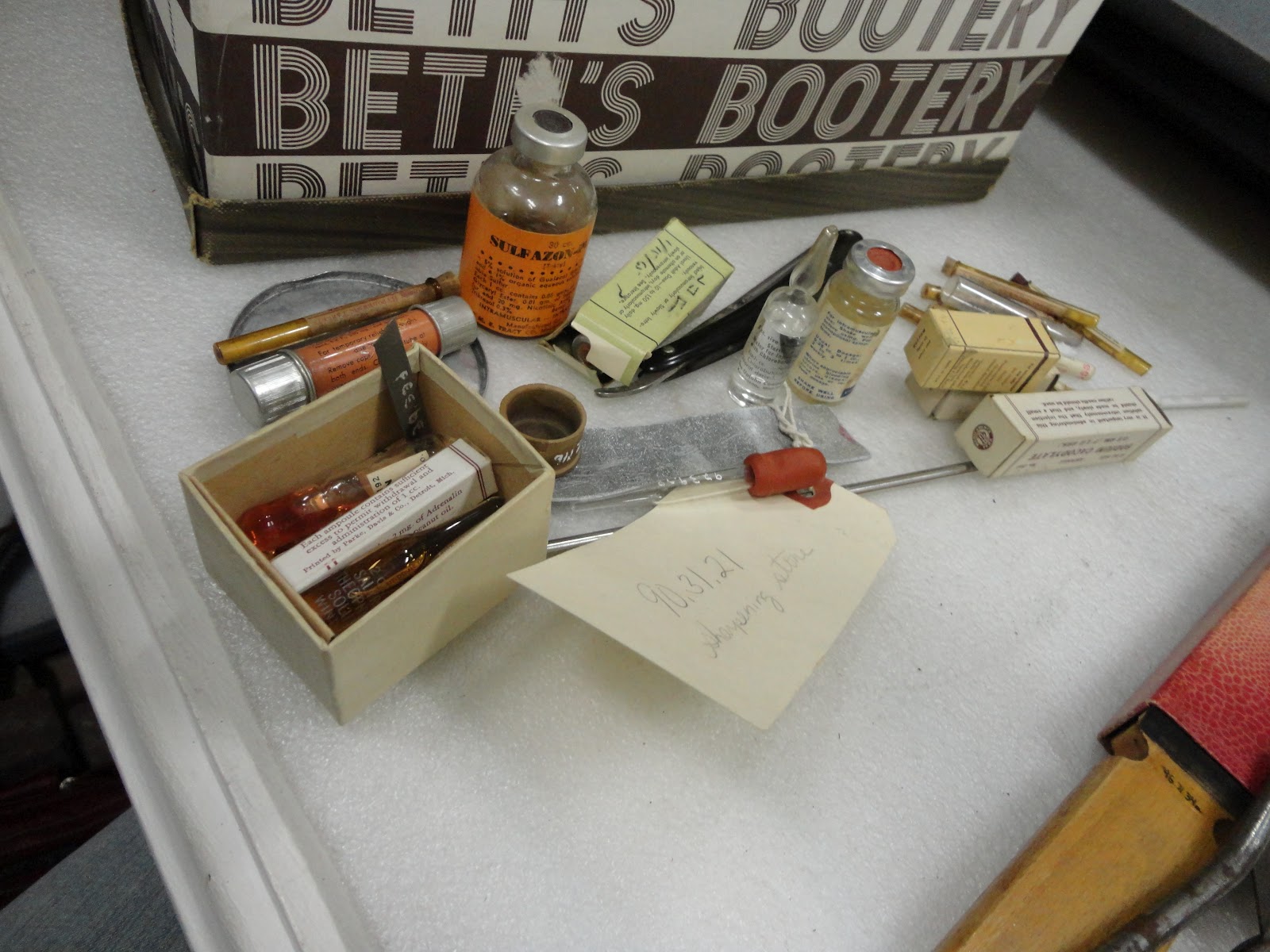
Lately, I've been going through a lot of medical supplies.  Three or four donations were made that consisted entirely of equipment, medications, etc. and fortunately just about everything in them was numbered.  Unfortunately:

  1. One donation doesn't have a list of items, just a gift agreement form that says, "1988.26.1-80: mostly medical equipment".
  2. One donation has some items labeled on the gift agreement, but with stretches of objects marked "unidentified medical tool".
  3. There are many boxes that are just full of stuff and took quite a while to go through.  On Tuesday I managed to get through roughly two shelves, when my usual rate is a whole shelving unit.
I documented my process with one of the more tightly packed boxes to give you an idea of what I'm dealing with.

  The box after I unpacked a small section of it.

Everything that was in that section.  There's a lot!

I took everything out and began cataloguing and putting the larger items in first - the boxes and that bottle of asafetida in a clear case.  The little box had assorted glass ampules*, but the others contained what was written on the label.

All of the loose bottles, some boxes, and some narrow pill tubes.

And here it is, all packed up!  My goal isn't exactly to make it look neater, but to try to get everything into such a position that the objects (especially the small glass ones) won't shift and possibly be crushed.  When you have little 1cc ampules and heavy brass trephines right next to each other, that's an important consideration.

* Ampules (or ampuls, or ampoules) are sealed containers, in this case, of medication.  Medicine ampules tend to be single dosages in glass capsules; most of these came in boxes with little files, so that the narrow neck could be safely broken and the medicine syringed up.

Here's another set:


There's a thin space on the left that could be filled in with a bit of archival paper, but because the boxes and tins fit together well there really isn't that much movement.

More aboutNitty Gritty

Museum Cataloguing and You!

Posted by Unknown

I have now finished my first week at my new internship at the Chapman Historical Museum!  It is going so well.  (You can see some examples of their photograph collection here.) My job there is to catalogue the collections in PastPerfect while identifying objects that could potentially be deaccessioned or that need accession numbers.  I usually talk about fashion history research here, but I thought I'd go into more detail about this side of museum work.  And now I will answer the questions you probably don't have.


What the heck is PastPerfect?
- PastPerfect is software designed specifically to manage collections.  It's pretty great!  I started slowly teaching myself to use it at AIHA, and the basics are fairly simple to work out.  There was one thing that completely threw me, and I didn't realize it until my last day, however.  Generally, "accession number" refers to the three-part numeric designation given to each object - in most cases, it's derived from the year the object was accessioned, the group it was accessioned with (which indicates the donor), and place of the object within the donation.  For example, 1978.024.0042: the forty-second item in the twenty-fourth donation (probably from the twenty-fourth donor) assigned a number in 1978.  However, in PastPerfect, this is called the "objectID".  "Accession number" refers to the first two-thirds - the indication of the donor.  It's a great function because it lets you put in the donor's name and the credit line in once and then autofills it for all other items in the donation group, and makes it possible to print out a list of all the objects one person donated - I think it can also write the deed of gift and thank-you letter automatically.

What about the objects that need numbers?
- If an object has no accession number on it, I bring it out of the shelves and put it aside for Jillian, the curator, to look at.  Most of the time, unnumbered objects are things somebody took in and put down on a vaguely appropriate shelf, and most of them are in terrible shape, so it's easy to weed those out.  Ones that are in good shape and fill a need get numbers in a new group - 2012.007 - and put back.

How do you catalogue a collection?
- To catalogue a collection, one systematically goes through the whole thing, noting at least the name, accession number, and location of each object.  It's also good to have a description that can identify each object on its own without the accession number, which I'm trying to do, and measurements, which I am doing on occasion.  Having a system is very important.  At the Chapman, the collections are divided into three parts: when you come in the door, furniture and art in frames are to the left, smaller objects are on numbered shelves in the center, and textile/dress objects are on racks or in boxes on shelves on the right.  I'm starting out with the center shelves, as the organization of the area makes it easy for me to make sure I'm taking care of all the objects.  After that, I'll do the furniture and farm implements, then the textile/dress items (most of which have been catalogued already) and the objects that are on view in the DeLong House.

What's the deal with names?
PastPerfect (and cataloguing in general) uses a system of nomenclature to organize objects and to keep things consistent internally and between museums.  Objects are first broken down into categories, like "Tools & Equipment for Materials", "Communication Artifacts", or "Building Components".  These are then broken down into sub-categories: some of those under "T&E for Materials" are "Food Processing T&E", "Food Service T&E",  and "Woodworking T&E".  The object name "fork" is under both "Food Processing" and "Food Service", because forks are used in both eating and in cooking - but the sub-category that you choose helps to describe the object even if you don't write a complete description.  While you can just go with "fork", there are also a number of fork types, again to add more description - "fork, serving", "fork, oyster", "fork, dinner", etc.

What if the object name you need isn't there?
 - There are two options.  One is adding a new object name to the lexicon, where it will appear under "Needs Classification/Unclassifiable" until you assign it to a sub-category.  Recently, I had to add "busk" (which will be filed under "Personal Artifacts/Clothing - Underwear") and "bottle, milk" (under "T&E for Materials/Food Processing T&E").  The other is that you're using the wrong name.  There is a certain amount of duplication ("dish" and "plate" both exist), but there is usually an alternate term already in the system.  Yesterday I came across three artifacts labeled "laundry plungers", which is not a term that exists in PastPerfect's lexicon, so before I added it I looked under "T&E for Science and Technology/Maintenance T&E", where I found "dolly, wash".  Since that's apparently the standard term, I used it instead.

I'm so interested in what goes into a description.  Can you go into more detail there?
- Sure! If an object is the only one of its kind in the collection, you don't need to do much.  Say it's a milk bottle - you always want to record text that's on an item so someone can check up on that without having to find it physically, but if it's the only milk bottle you can probably let it go with that.  If there are many milk bottles, as there sometimes are, you want to note all of the aspects where they differ - round or squared, long or short neck, the color of the text.  If two objects are exactly the same, though, don't stress it.  If they're consecutive numbers, just put them in one entry! They may already share accession numbers with a letter on the end if they're part of a group of similar items - you tend to see this with silverware, teacups, etc.  The description of the corset I'm working on that's in my line of sight would be something like: "long corset of plain-woven beige material with cotton twill tape binding; six bones per side, with a metal split busk; large brass two-piece grommets".  If I had multiple beige post-Edwardian corsets, I might use the shapes of the pieces or of the top and bottom edges to distinguish between them.
More aboutMuseum Cataloguing and You!