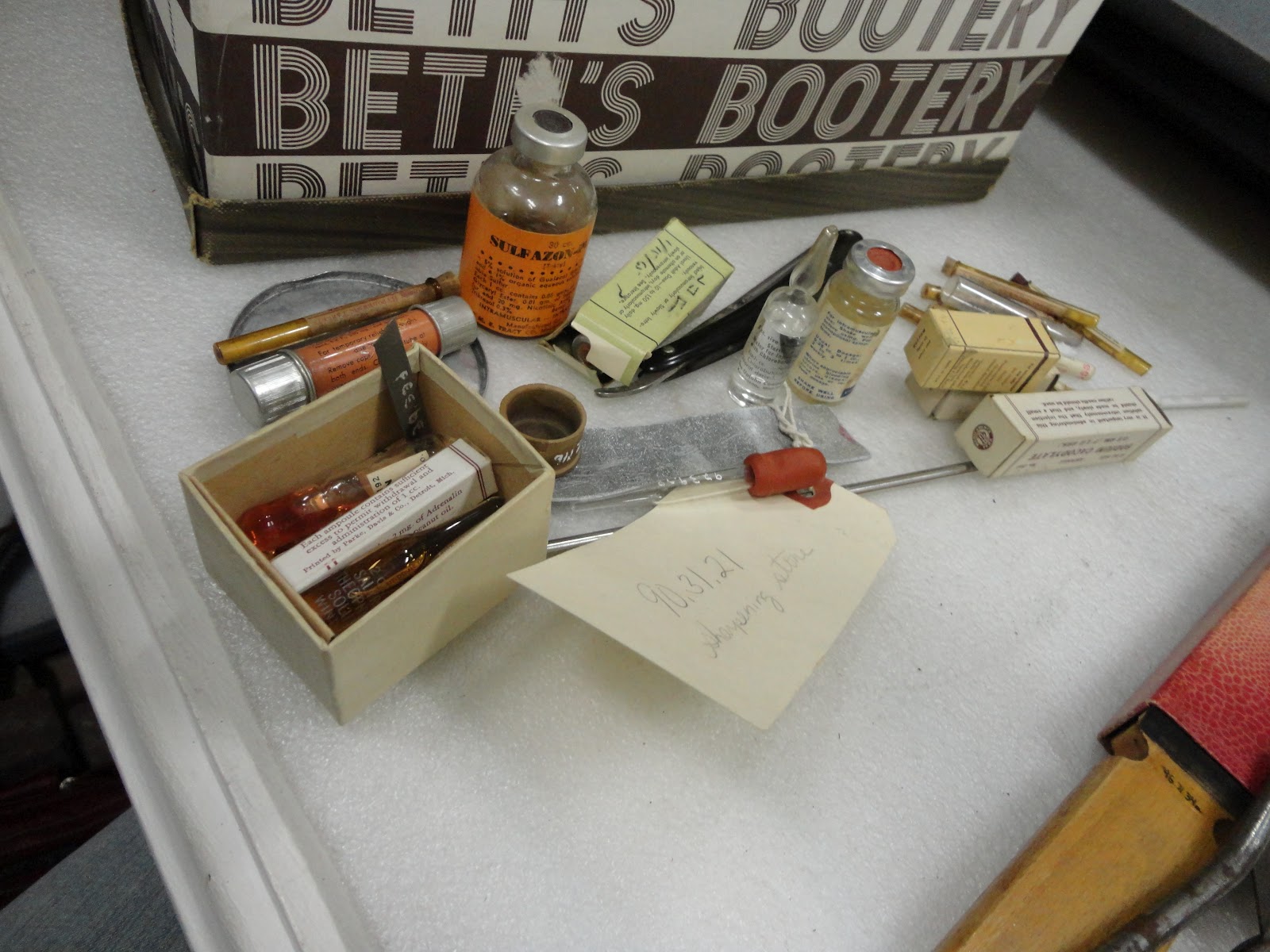
I have now finished my first week at my new internship at the
Chapman Historical Museum! It is going
so well. (You can see some examples of their photograph collection
here.) My job there is to catalogue the collections in PastPerfect while identifying objects that could potentially be deaccessioned or that need accession numbers. I usually talk about fashion history research here, but I thought I'd go into more detail about this side of museum work. And now I will answer the questions you probably don't have.
What the heck is PastPerfect?- PastPerfect is software designed specifically to manage collections. It's pretty great! I started slowly teaching myself to use it at AIHA, and the basics are fairly simple to work out. There was one thing that completely threw me, and I didn't realize it until my last day, however. Generally, "accession number" refers to the three-part numeric designation given to each object - in most cases, it's derived from the year the object was accessioned, the group it was accessioned with (which indicates the donor), and place of the object within the donation. For example, 1978.024.0042: the forty-second item in the twenty-fourth donation (probably from the twenty-fourth donor) assigned a number in 1978. However, in PastPerfect, this is called the "objectID". "Accession number" refers to the first two-thirds - the indication of the donor. It's a great function because it lets you put in the donor's name and the credit line in once and then autofills it for all other items in the donation group, and makes it possible to print out a list of all the objects one person donated - I think it can also write the deed of gift and thank-you letter automatically.
What about the objects that need numbers?- If an object has no accession number on it, I bring it out of the shelves and put it aside for Jillian, the curator, to look at. Most of the time, unnumbered objects are things somebody took in and put down on a vaguely appropriate shelf, and most of them are in terrible shape, so it's easy to weed those out. Ones that are in good shape and fill a need get numbers in a new group - 2012.007 - and put back.
How do you catalogue a collection? - To catalogue a collection, one systematically goes through the whole thing, noting at least the name, accession number, and location of each object. It's also good to have a description that can identify each object on its own without the accession number, which I'm trying to do, and measurements, which I am doing on occasion. Having a system is very important. At the Chapman, the collections are divided into three parts: when you come in the door, furniture and art in frames are to the left, smaller objects are on numbered shelves in the center, and textile/dress objects are on racks or in boxes on shelves on the right. I'm starting out with the center shelves, as the organization of the area makes it easy for me to make sure I'm taking care of all the objects. After that, I'll do the furniture and farm implements, then the textile/dress items (most of which have been catalogued already) and the objects that are on view in the DeLong House.
What's the deal with names?- PastPerfect (and cataloguing in general) uses a system of nomenclature to organize objects and to keep things consistent internally and between museums. Objects are first broken down into categories, like "Tools & Equipment for Materials", "Communication Artifacts", or "Building Components". These are then broken down into sub-categories: some of those under "T&E for Materials" are "Food Processing T&E", "Food Service T&E", and "Woodworking T&E". The object name "fork" is under both "Food Processing" and "Food Service", because forks are used in both eating and in cooking - but the sub-category that you choose helps to describe the object even if you don't write a complete description. While you can just go with "fork", there are also a number of fork types, again to add more description - "fork, serving", "fork, oyster", "fork, dinner", etc.
What if the object name you need isn't there? - There are two options. One is adding a new object name to the lexicon, where it will appear under "Needs Classification/Unclassifiable" until you assign it to a sub-category. Recently, I had to add "busk" (which will be filed under "Personal Artifacts/Clothing - Underwear") and "bottle, milk" (under "T&E for Materials/Food Processing T&E"). The other is that you're using the wrong name. There is a certain amount of duplication ("dish" and "plate" both exist), but there is usually an alternate term already in the system. Yesterday I came across three artifacts labeled "laundry plungers", which is not a term that exists in PastPerfect's lexicon, so before I added it I looked under "T&E for Science and Technology/Maintenance T&E", where I found "dolly, wash". Since that's apparently the standard term, I used it instead.
I'm so interested in what goes into a description. Can you go into more detail there?- Sure! If an object is the only one of its kind in the collection, you don't need to do much. Say it's a milk bottle - you always want to record text that's on an item so someone can check up on that without having to find it physically, but if it's the only milk bottle you can probably let it go with that. If there are many milk bottles, as there sometimes are, you want to note all of the aspects where they differ - round or squared, long or short neck, the color of the text. If two objects are exactly the same, though, don't stress it. If they're consecutive numbers, just put them in one entry! They may already share accession numbers with a letter on the end if they're part of a group of similar items - you tend to see this with silverware, teacups, etc. The description of the corset I'm working on that's in my line of sight would be something like: "long corset of plain-woven beige material with cotton twill tape binding; six bones per side, with a metal split busk; large brass two-piece grommets". If I had multiple beige post-Edwardian corsets, I might use the shapes of the pieces or of the top and bottom edges to distinguish between them.