Showing posts with label mythbusters. Show all posts

The Myth of Chanel and the 1920s: X - Rising Hems

Posted by Unknown

As hem lengths rose and flowerpot hats moulded themselves to the side of the head, a voluntary simplification of clothing spread across a wide spectrum of society.

The hemline was on a slow rise from the beginning of the twentieth century.  The stereotypical Edwardian skirt, for example, had a shape like an upturned lily, with a train even in daywear.  According to Vogue, the skirt began to shorten in 1907, due to some sort of alleged American influence - however, looking through fashion plates and advertisements, the change is more gradual than sudden.  It is not until 1909 that fashion truly got rid of the train and showcased narrower skirts, and not until 1910 or 1911 that the top of the foot was exposed.

(This post is fairly image-heavy - I feel the point's best made by showing specifics.)

Debenham & Freebody advertisement, April 1915; NYPL 816928
Bradleys advertisement, September 1916; NYPL 816904
Bonwit Teller advertisement, Harper's Bazaar September 1917; NYPL 816925

The skirt first widened into a flowing, full shape, then began to creep up the leg again.  To our eyes, the 1916 skirt appears long and the 1917 skirt is quite modest, but from the perspective of someone who had grown up in the previous few decades this would have been a significant change from the floor-brushing gowns of the 1900s.
Lord & Taylor advertisement, September 1918; NYPL 816926
Debenham & Freebody advertisement, January 1918; NYPL 816685
"Mme Ida Rubenstein, dressed by Worth", André-Edouard Marty, 1919; MMA 1973.516.3
During 1918, there were competing hemlines - ankle-length skirts, and skirts at the mid-lower-calf - but the longer skirt failed to make a comeback at that time, and the slow climb up the leg continued.

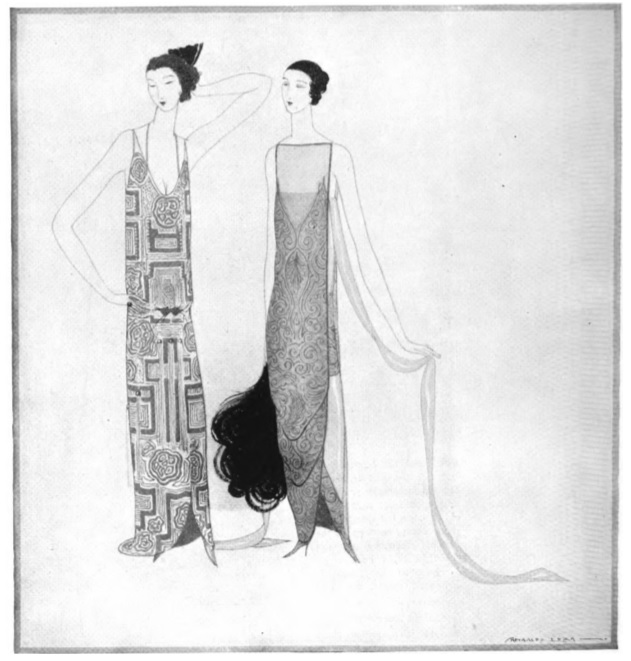
Evening dress design, Hilda Steward, 1920; VAM E.1045-1988
"Fumée - Robe du soir, de Beer", Gazette du Bon Ton, 1921; MFA 2004.36.8
Costume print, Erté, 1922; MMA 47.53.18
However, the skirt had hit its high around 1920, and by 1922 it had returned to roughly the level it had been in 1914, and it would not rise again until 1924 or 1925.

The narrative of skirts suddenly shortening due to women's new-found independence after the war only works if one takes a quick view, comparing a fashion plate from 1914 to one from 1919 - and adding one from the later 1920s into the mix creates the impression that the "sudden jump" in 1919 remained in place for the next decade.  But this skirt-shortening was not a leap made in 1919, cannot be laid at Chanel's door, and, if one is trying to relate it to a statement on society, a more nuanced discussion involving research into the longer skirts of the early 1920s must take place.

I have already discussed the notion of an increased simplicity, so I will move on to the last point in this series, one which is less related to Chanel but is highly connected to the popular conception of the 1920s - the cloche hat.

"Cloche" is the term given to the iconic headwear of the 1920s, which is perhaps only second to the Castle band.  However, it actually was not the most fashionable option during the romantic years following the war.  Fashion vacillated between non-existent, small, and large brims, but the crown of the hat was usually larger and softer if the brim was small.
Good Housekeeping, 1919
"The Modes Indorses Brims for Fall and Winter", Ladies Home Journal, September 1921
"Alina Tell", Theatre, February 1922, p. 115

The cloche does appear as early as 1920, but these early mentions do not go along with illustrations showing "flowerpot hats".  The hat of that shape does not really appear until 1924 or 1925, just as the beaded, short "flapper dress" does not appear until that time.

Why is it that so many stereotypes about the 1920s exist?  My belief is that nostalgia in the following decades, during a time when fashion history was barely studied and period movies were more concerned with incorporating contemporary aesthetics than accuracy, promoted a very rigid idea of what the 1920s were like.  Women all shingled their hair, hats and clothing were plain and form-fitting, and legs were always on view.  And while there's not much harm in the general public being unaware of the niceties of historical dress or which designer had the most clout, the political and feminist viewpoints that are attached to this time period are strongly influenced by impressions of the clothing - short skirts, no corsets, and tiny, light hats - and the particular couturiers we associate with them.  The past provides a prism through which we understand the present day and the future, so an accurate view of women's roles and rights through history is necessary to accurately evaluating where we are now and where we are going.

More about → The Myth of Chanel and the 1920s: X - Rising Hems

The Myth of Chanel and the 1920s: IX - The Bob

Posted by Unknown

She cut her hair short 'because it annoyed me'.  Everyone cut off their hair in imitation.

This is probably the most concretely bustable myth about Chanel.  It is very popular, appearing frequently in fashion blogs.  Even when academic writers acknowledge that she did not invent the style, she is given top billing and the bulk of the credit for popularizing such a daring innovation.

The main strike against it is that the date of her bob is given as 1916 or 1917 (one blog calls this "long before the look became popular", which will be refuted in a minute).  As was demonstrated in Part II, Chanel was successful but not the über-popular figure until later in the 1920s, and it would be difficult for her to have such a widespread effect midway through the 1910s or early in the 1920s.

1916 or 1917, that is still later than 1915, which is when the bob starts to be discussed in magazines.  In madly famous dancer Irene Castle's own words:
The next time I heard the call of the scissors was just before I was going into the hospital to be operated on for appendicitis. I never liked having anyone comb my hair, so, to assure as little combing as possible, I cut it all off. I say all; it never fell much below my shoulders.

After I came out of the hospital I tried to cover up my clipped head by wearing, whenever I appeared in public, a tight turban or toque under which I tucked every spear of hair except some little square sideburns. Those of my friends who saw me in the country without a hat begged me to wear my short hair in public, and so one night when we were going to town to dinner I wore it down, and in order to keep it in place wrapped a flat seed-pearl necklace around my forehead—which was, I think, the beginning of what they afterwards called the “Castle Band.”
From The Dry Goods Reporter, June 1915, p. 34
 In 1915, references to the Castle Bob (either as an actual haircut or as a sort of hairpiece) and its popularity among young and old started to pop up, and they proliferated in 1916.  Whether or not Chanel had the star power to make the bob at this time, it was consistently attributed to Irene Castle and it was regarded as popular before Chanel was supposed to have cut her own hair.

Chanel's own account of the bob was apt to change.  She first stated that she shortened it bit by bit because, as Nicholson quoted, it annoyed her; later, the story was that a sudden gas burner explosion dirtied her hair and her reaction was to chop it off as her maid begged her to stop.  It's impossible to determine which story is true, but it must be acknowledged that one is certainly more theatrical and interesting than the other, and that Chanel is known to have invented myths about herself to suit her personal and business needs.

"Good taste in children's dresses", pattern magazine, 1914; NYPL 816966
In addition, young girls of the 1910s commonly wore their hair short.  They also wore waistless and dropped-waist dresses, which would become as common as the bob in the 1920s, and it's quite possible that these elements' transition from children's dress to fashionable dress are related.

Lastly, I would like to note that in 1931 Chanel told a reporter from the New York Times that "long hair would be coming back into general fashion soon.  If a few smart women wear their hair long the rest will follow."  She was aware that hair length was a fashion choice, rather than a reliable indicator of independence or modernity.
More about → The Myth of Chanel and the 1920s: IX - The Bob

The Myth of Chanel and the 1920s: VIII - Expensive Poverty

Posted by Unknown

The flamboyant colors of Paul Poiret's pre-war designs and the theatricality of Bakst's influential costumes for the Ballets Russes suddenly seemed tawdry and overdone. ... A look of luxury was achievable through the severity of simplicity.  Expensive poverty was the aim.  She dared to suggest that clothes themselves had ceased to matter and that it was the individual who counted.

The story of the first three decades of the twentieth century can be seen as a narrative of increasing simplicity.  Not to continually beat Poiret's drum - no single designer can be held responsible for such a grand shift in style - but his simple black kimono coat, originally introduced in 1903 (itself deriving from the frequent use of orientalism in fashion and interior design in the late nineteenth century rather than springing forth from Poiret's head fully formed) started the general trend in outerwear.

Lord & Taylor advertisement, Burr-McIntosh Monthly, December 1907; NYPL 816513
Other designers followed suit, leading to the incongruous pairing of ornate turn-of-the-century evening gowns in a multitude of frothy fabrics with plain, unshaped, and unstructured evening coats. The columnar coats' success likely led to Poiret's introduction of the Directoire revival by the end of the decade.  While the newer high-waisted fashions could certainly be heavily embellished and somewhat form-fitting, the overall trend was toward a kind of simplicity that prized rich, relatively unadorned fabrics and their drape, with ornamentation concentrated only or mostly on the bodice.  (It must be noted that unadorned evening dresses were worn by the very wealthy before this point as well, however.)

"Étole et manchon d'hermine des Fourrures Max", Les Modes, 1909; NYPL 818412
The shift to a higher waistline also led necessarily to one-piece gowns becoming the norm, which further simplified construction.  In general, the turn of the previous century was seen as a time of great simplicity in dress, and it is clear from Iribe's 1908 Les Robes de Paul Poiret that imitating Austen-era clothing was the goal.

pp. 2-3
But this does not directly contradict Nicholson's claim that Chanel invented simplicity, as simplicity in cut, ornamentation, and color are not the same things, and these are quite bright colors.  What would be more apropos would be to look at Chanel's early years once again, to evaluate her severity and poverty.  Did she really advocate a starkly plain, unembellished style?


At the right is a popular dancing frock by Chanel, fashioned from black filet embroidered with black and white flowers and silver leaves.  As always with Chanel, the bodice is transparent to yoke depth and the black satin foundation is edged with a narrow band of silver lace at the bottom. 
- Ladies Home Journal, Dec. 1921, p. 91

The Chanel gown of white crêpe de Chine at right shows Valenciennes edging and a pearl-studded girdle. 
- Good Housekeeping, March 1922, p. 34

Chanel uses homespun in half inch checks in which browns and all the dull and vivid shades of yellow predominate, combined with blue, gray, or rust.  One of these coarse stuffs in tawny yellow and green is especially new and smart ... 
- Harper's Bazaar, January 1922, p. 49

Mademoiselle Chanel wore a chemise of gold and beige lace arranged in alternate crosswise bands and girdled at the top of the hips.  Lovely in color was this frock, worn with many ropes of pearls.
- Harper's Bazaar, March 1922, p. 38

Russian embroideries now adorn many of the Chanel corsages: the needlework is often disposed of in crosswise bands on corsage and sleeve alike, and also on the small smart hat. ... The velvet wraps are lined with Georgette crêpe or crêpe de Chine, matching the frock underneath. 
- Harper's Bazaar, April 1922, p. 140

See below.
Occasionally Chanel goes in for something as naive and simple as this three-piece costume of gray crêpe made with a straight little frock with an apron that actually has apron strings and two little pockets besides. Incidentally a great many buttons and buttonholes that are not in the least concerned with coming together give the bodice an air of complete detachment. 
- Harper's Bazaar, May 1922, p. 73

So gorgeous is the embroidery in gold and Paisley colors on this Chanel wrap that only the cut saves it from being an evening wrap. The richness of the fabric (black "Juina" cloth overlaid with silk machine embroidery) is enhanced by the trimming of monkey fur. A chemise dress with sleeves and bodice embroidered to match accompanies the coat.
- Harper's Bazaar, September 1922, p. 84

Callot is showing, as usual, her collection of strange, exotic, ever marvelous, embroidered gowns. What a contrast they are to Chanel's gowns! Callot designs the gown to decorate the woman, whilst Chanel conceives clothes from an entirely different angle; the individuality of the woman predominates, the gown is designed as but a background.  Although skirts and waists daily grow longer here, Mademoiselle Chanel still remains a delightful exception. She clings to her short and narrow styles, which she herself wears - how well I hardly need say as every one knows her, if only by sight. These suit her youthful type, especially as she generally relieves the extreme simplicity and girlishness of her appearance by adding many gorgeous strings of pearls of dazzling luster. Chanel has succeeded in making simplicity, costly simplicity, the keynote of the fashion of the day. 
- Harper's Bazaar, August 1922, p. 51

The last quote is quite explicit - vehement, even - in its declaration that Chanel's driving forces were "costly simplicity" and individualism.  However, it stands in direct opposition to numerous lavish descriptions of her designs - bright yellows, silver lace, Russian embroidery, monkey fur.  Even Chanel's "naive and simple" suit appears a little fussy, and it is covered with non-functional buttons.

How does one reconcile these two opposing viewpoints?  For one thing, it is important to note that the last quote is mostly discussing Chanel's own appearance.  By all accounts, she did dress in a starkly plain manner through her life, and I'm sure that the description of her in Harper's (along with the accompanying illustration) was accurate.

For another, one has to consider the fact that "simplicity" is a very subjective term.  It's a relative concept, depending on what is seen as ornate or complicated and what is seen as ordinary.  Around the turn of the century, "simple" seems to have meant anything fairly untrimmed, regardless of the complexity of the cut. Similarly, it's possible that what Harper's calls "simple" is a plainly-cut garment that may or may not be lavishly trimmed or made of elaborately patterned material.  Modern clothing has become so simplified (for lack of a better word) that an unqualified use of "simplicity" in a contemporary source implies what appears simple to our eyes, and therefore gives Chanel's work a more modern sheen.

And, in addition to all of this, the context should be remembered.  A fashion magazine is not an unbiased, completely factual source.  The visual evidence of the illustrations and the descriptions of specific garments from fashion shows are more concrete information for evaluating Chanel's design style at this point in her career.
More about → The Myth of Chanel and the 1920s: VIII - Expensive Poverty

The Myth of Chanel and the 1920s: VII - Jersey Cloth

Posted by Unknown

During the war she discovered the versatility of jersey cloth as used by stable lads for shirts for training sessions, and began to make sweaters and waistless dresses for women from the same supple fabric.  The ornate Edwardian costume that according to a scornful Chanel had 'stifled the body's architecture' started to disappear. 

Chanel was quite certainly not designing waistless dresses from the beginning of her dressmaking career (as evinced by the plate below), and of course the "stifling" Edwardian costume was gradually evolving on its own.  Fashionable dress was much looser at the waist, but still frequently had a defined waistline, and even Chanel partook in the general complication in decoration and fastening that fashion involved at the time.

"Jersey Outfits; Designs by Gabrielle Channel [sic]", Les Elegances parisiennes, March 1917
However - again, as evinced by the plate - jersey did play a significant role in Chanel's career.  There are varying reasons given for this: that jersey was the only fabric she could buy in bulk or that she got a large amount of it cheaply, that she used stablehands' sweaters for her raw materials, that had to start with a non-dress fabric to avoid violating the terms of her lease.  And Chanel did continue to show jersey dresses into the beginning of her career, probably more than other designers did, but others were using jersey in haute couture by 1916 as well.  It is possible that their use of the fabric was based on her own success, but there is something else important to consider.
Good Housekeeping, September 1918, p. 9
Jersey fabric was seen as a sensible choice for consumers like "business [or] professional women" who required a sturdy and lasting cloth, especially when it was made in rayon.  It was also handy from a price point of view, as jerseys were (and are) made in the round, allowing for simpler cutting.  When woven wool cloth was in shorter supply due to the war, it was seen as an acceptable substitute for use in fashionable dress.

Boston Symphony Orchestra Program, 1917-1918, p. 1274
The explosion of jersey during the war years (although it appears to have been used in women's dress as early as 1880) occurred too quickly to have been due to a single woman's idea and limited influence among the smarter set.  Indeed, while Chanel seems to have been leading the way with jersey in the couture world, the majority of the references I find to it in period texts are aimed at women "who appreciate quality and reasonable prices", who were trying to make ends meet during wartime.  Its use in Red Cross uniforms (due to the fact that it was warm and didn't require much washing - so practical that nobody cared that it went against regulations) probably also spurred an understanding of the material's advantages.  It is seen more frequently in high fashion after the war than before it, but the references actually fly thick and fast in magazines selling patterns for the middle-class consumer.

Jersey is part of Chanel's story, but the trouble is that the way it's usually presented as her sole discovery combined with the fact that much of our clothing today is made of knits implies a far greater influence on her part than exists.
More about → The Myth of Chanel and the 1920s: VII - Jersey Cloth

The Myth of Chanel and the 1920s: VI - Femininity and Androgyny

Posted by Unknown

Vionnet cleverly amalgamated a still lingering desire for femininity with the wish to dress without the restricting comfort of corsetry. ... But it was the androgyny promoted by Chanel that dominated women's fashion in Europe in 1919.

The idea that Chanel suddenly brought out a less curvaceous figure in 1919 has already been dealt with, so I thought I'd go a bit more academic on this one, if you'll forgive me.

A large problem with the discourse around dress of the 1920s in both pop culture and academia is the feminine/androgynous dichotomy - the idea that the fashion of a particular era is either feminine or androgynous (sometimes "masculine" is the word used for the opposite pole, and in this case, androgyny appears to mean, essentially, "masculinity in female dress"), and that these are two mutually exclusive adjectives.

The trouble is that you can't define anything as objectively feminine, or objectively masculine, because these attributes are determined by socially-constructed roles, which shift with society.  What is masculine in one era may be feminine in another, and vice versa!  (See: the role of pink and blue in baby clothes.) It's too easy to judge the past by present-day standards in this regard - what we consider masculine, feminine, a combination of both, or neither - rather than to try to see what contemporaries would have pinpointed as any of those choices of adjective.
"The June Bridal Party is Gowned in White", models by Miss Steinmetz, Harper's Bazaar, May 1922, p. 70
There are a few indisputable facts.  The fashionable figure of the 1920s was sometimes considered "boyish" by contemporaries, both in praise and condemnation, and touches from menswear continued to be incorporated into women's clothing.  But the following quote (from Harper's Bazaar, December 1922, p. 53) provides a good look at the way fashion tended to play out:
For the street and for almost all daytime costumes, except those for formal afternoon wear, [Peggy Hoyt] makes the smart woman a youthful, boyish person, given to wearing little velvet costumes with Eton or Fauntleroy collars, trimmed with many tiny buttons and braiding.  Sometimes these costumes look as if they had stepped out of "David Copperfield"; again, there is a romantic frill of lace at the throat and cuffs to remind us of the gallant little figure of Sir Joshua Reynolds' famous Blue Boy. ... These costumes are very much part of the modern spirit. ...
In the evening, this youthful and rather boyish young person Miss Hoyt changes entirely by the simple magic of costume.  She turns from the naive Eton collar and short bolero jacket to the full and enveloping skirts of the "picture gown."  The smart woman now becomes a romantic figure from eighteenth century Venice, or a gracious feminine lady, flounced and ruffled, like those charming tiny-waisted persons in Godey's Ladies Book. ... She wears silver lace, soft satins, veilings of chiffon.  She trails voluminous wraps of lace and rich stuffs and fur about her.  She is femininity: she is everything that is gracious; she is romance.
Even though that slim figure (which related more to young, lissome women than to boys) was fashionable, it's important to consider what was worn over it.  Far from there being "a still lingering desire for femininity" represented by a single designer's work, much of early 1920s fashion reflected a stereotypical and historical type of femininity.  It was understood that much sporty daywear took inspiration from men's clothing - as had been happening for centuries, with women's riding habits in the eighteenth century, Regency spencers, and Victorian tailor-mades: this was not a new concept for Western society.  But eveningwear (and dressy afternoon-wear) continued to be seen as a different beast.
Peggy Hoyt models, Harper's Bazaar, August 1922, p. 77
As stated in the article and shown in fashion plates too numerous to count, evening dress was still allowed and encouraged to be romantic, soft, and stereotypically/historically feminine.  The full-skirted look* was not as hugely successful as the straight chemise line, but it had a short period of prevalence in the higher-end fashion magazines, and persisted in existing all the way through the decade.  And even in those slender gowns without full skirts, light chiffons and silks as well as intricate trims were frequently used to create an appearance that spoke to traditional femininity.

And, of course, one must address the corset.  Corsetry and femininity are very strongly linked in the public imagination - corsets equal a curved hourglass shape which suggests an exaggerated form of femininity.  There is much discourse about women's bodies being oppressed and confined into an overtly feminine shape, and it is often assumed that removing the corset thus equates to a removal of patriarchal oppression.
From "Inspirations", Harper's Bazaar, 1916, p.?  
The corset of the 1910s was not intended to create a very curvaceous figure.  Most advertisements focus on the "line" - smoothing the body for an elegant shape (exactly as our modern Spanx and other shapers are intended to do), and making it easier to fit dresses to the body.  They could be bought for any body shape, but they were meant to "guide the figure into womanly contour" or "coax the body into perfect poise".  Irene Castle, the famous dancer, even claimed in an advertising testimonial that her Redfern corset was more comfortable than not wearing one at all.  Photographs of the late 1910s show women with completely ordinary-looking figures - for the most part, unless you were aware that corsets were still commonly worn, you would think that the subjects had already tossed them away.

Vionnet evening gown, pictured in Harper's Bazaar, January 1922, p. 25
Similarly, when examining photographs of women of the 1920s, their casual figures give the impression that they've been liberated from their bodily oppression.  But in reading periodicals and catalogues of that decade, it becomes clear that the corset had hardly vanished.  In fact, while many could get by with only a waist-high girdle and a separate brassiere - which, at the time, was much closer to the cosplayer's binder than the modern cup-and-lift undergarment - others wore a full-torso, elasticated corset with straps to hold it in place.  While actual fashion was not as unforgiving as the high-end fashion plates and caricatures of the later 1920s would make it appear (just as we accept today that fashion illustrations and runway models have figures that are impossible for us to achieve), the "boyish, youthful" figure was and is not the default corsetless state of every woman's body.  Corset companies frequently took out full-page advertisements, the expense of which implies that their business was not suffering.  A dress was still considered to fit and hang better when worn over a corset.

Ladies' Home Journal, September 1921, p. 153
Once again, the reality of 1920s fashion is that it grew organically out of 1910s fashion.  The under- and outerwear of 1920 resembled that of 1918 more than that of 1928, because there was not a severe break with tradition in 1919 that created a brand-new style.

* Just a note on this type of dress.  It's generally called the robe de style, because a) a few fashion plates label it as such, and b) we fashion historians love having specific names for specific styles of dress (as well as specific traits to pin to specific designers).  But in the research I've done recently on the 1920s, it's become fairly clear to me that the vast majority of people and designers and fashion editors would refer to it as the "bouffant look"/the "full-skirted silhouette" or simply call them evening or afternoon dresses with various adjectives such as "romantic", "nostalgic", "old-fashioned", &c.  Robe de style is not an anachronistic term, but it seems to me that calling every full-skirted 1920s dress a robe de style as though they were seen as unrelated to "ordinary" dress is not true to history.
More about → The Myth of Chanel and the 1920s: VI - Femininity and Androgyny

The Myth of Chanel and the 1920s: V - Outdated Old Masters

Posted by Unknown

The subsequent single-page spread devoted to Madame Lucile's chiffons and to Poiret's plumes seemed to be included simply out of respect for the old masters and appeared fearfully outdated.
This part of the Chanel myth breaks down into two ideas: that pre-1919 looks appeared outdated compared to Chanel, and that the top designers of the 1910s were suddenly displaced.
Harper's Bazaar, May 1922, p. 78; a selection of fashionable and typical Poiret frocks
The latter myth was mainly dealt with in II (Standing Out from the Crowd) and IV (The Sole Survivors).  The post-war designers were, in the main, the pre-war designers.  Lucile and Poiret are nearly always (if not actually always) the go-to examples to show Chanel's superiority, but as was previously discussed, Poiret had always been strongly in favor of simplicity and plain cuts, and Lucile's exit from her house stemmed from legal issues rather than becoming obsolete.  Paquin, Callot, and Jenny boomed over this period, achieving far greater success than Chanel in the late 1910s and early '20s.  The narrative of a single young woman standing up to an antique establishment is attractive but does not fit the facts (especially as Gabrielle Chanel was 36 in 1919 and Paul Poiret was 40).

Fashion plate from L'art decoratif, 1912; NYPL 816894
As was mentioned in part I (A Sea Change), there was a continuity in fashion from 1910 to 1920, with no abrupt breaks.  Probably because most period films of the era are costumed in it, Directoire fashions are seen as the style most emblematic of the 1910s, but they were really only typical of the first half of the decade.  In 1913 and 1914, flared knee-length overskirts were added to the narrow silhouette, paving the way for the entire skirt to be flared in 1915.  At this time, the waist began to drop, hitting the natural level and creating an hourglass silhouette at the same time as a loose-waisted look was developed.

Advertisement, Harper's Bazaar, September, 1917; NYPL 816925
Fashionable dresses of the war years were a clear step to those of the period after.  The dropped waistline, the straight bodice, the simple closure (even the "slip-over dress") - these are all the key points of post-war fashion, and they were all in evidence before Chanel's alleged revolution.  It is difficult to believe that Chanel's elegant little number would make such a contrast with the standard fashions of 1919, because fashion flowed quite naturally from the 1910s to the 1920s.

Lord & Taylor advertisement, Vogue, September 1918; NYPL 816926
Photograph, Joseph, January 1921; NYPL 817146
And a final note.  Floating chiffon layers were part of those Directoire styles that are thought of as emblematic of the 1910s, but they declined in popularity after 1914.  During the war years, they turned up in a more subdued, less noticeable way - even when used by Lucile.  And it must also be noted that highly fashionable dresses of the early 1920s also made use of chiffon, with dozens of chiffon gowns in the issues of Harper's Bazaar of 1922.  The way chiffon was used changed over time, as the overall silhouette did: "Madame Lucile's chiffons" would most likely have not appeared outdated to the readers of the issue of Vogue that Nicholson is referring to.  When examining historical sources, it is important to leave preconceptions behind, and not to assume that the strong divisions between "modern" and "old-fashioned" we perceive necessarily existed for those sources' contemporaries.
More about → The Myth of Chanel and the 1920s: V - Outdated Old Masters

The Myth of Chanel and the 1920s: IV - The Sole Survivors

Posted by Unknown

One other French designer, Madeleine Vionnet, managed to survive the transition through the war years and become part of the revolution in fashion.
The unfortunate truth is that Chanel and Vionnet have come through history with somewhat undeserved reputations.  They are remembered, and are therefore considered to have been the leading two couturiers - because why would they be the only two well-remembered designers of the 1920s if they weren't at the top of the game?  But the idea is easily refuted with a little research.

"Longchamp (II), or, She's lost!", Gazette du Bon Ton, 1915; NYPL 824772
(Speaking of research - I keep going back and forth over whether or not I should cite sources. It's more professional to do so, but then, the purpose of citations is to let readers view your sources for themselves.  In an online format, however, a link to the exact page I would have cited streamlines the text and lets the reader skip a step in the process.  So please do click the links for published, academic information on these topics!)

The following is a list of couture houses that survived WWI.  I was going to write it out in prose, but it's lengthy, and perhaps makes the point better this way.  The list is not complete - there are a number of fashion houses of the 1920s that I simply cannot find enough information on to present here.


Doucet (1871-1929, Jacques Doucet's death; merged with Doeuillet; Drécoll-Doeuillet closed in the 1930s)
Redfern (1871, inclusion of women's dress-1932)
Worth (1871-1956)
Paquin (1891-1956)
Lucile (1894-1922, end of Lady Duff Gordon's association with house; Lucile closed soon after)
Callot Soeurs (1895-1939)
Drécoll (1896 (Vienna), 1902 (Paris)-1930, merged with Beer; 1931, merged with Agnes)
Agnes (1898-1931, merged with Drécoll)
Boué Soeurs (1899-1937, re-opened, closed again in 1950s)
Doeuillet (1900-1928, his death; merged with Drécoll)
Poiret (1903-1929)
Beer (1905-1929 – merged with Drécoll)
Chéruit (1906-1935)
Jenny (1908/1911-1938)
Lanvin (1909-)
Patou (1910 (as Maison Parry)-1987)
Premet (1911-1931)
Vionnet (1912-1939)
Chanel (1913-)

Surviving the first war was not easy.  Poiret is known as one house that suffered greatly from it: Paul Poiret put fashion on hold to design for the military, which had a noticeable effect on his family's finances, and was attacked for his connections to the Austrian Wiener Werkstätte artistic community.  The story of his fall - how he was unable to cope with the changed times after the war - is legendary, but when one considers that Maison Poiret didn't close until 1929, a full decade after the end of the war, the story has to be made less extreme; a more gradual downfall, a more modest lack of success.

Postcard from Biarritz, ca. 1905; eBay
Chanel's own success during the war can be largely attributed to the fact that, at that time, she was based in Deauville and Biarritz - resort towns - rather than solely war-torn Paris.  Biarritz was an especially profitable place for a high-end designer as it was situated near neutral Spain, assuring her a wealthy tourist clientele, and apparently hosted no real competition in her market.

The end of the 1920s proved to be a difficult time for several top couturiers.  Doucet, Redfern, Drécoll, Agnes, Doeuillet, Beer, Poiret, and Premet all closed or merged around the time of the disastrous stock market crash that affected the world's economy.  The luxury market did not completely implode, but customers were in shorter supply than they had previously been, increasing competition.  This would be a much more appropriate setting for a narrative about the true merits and timeliness of various designers determining their success (although, as with the more common narrative, it would still not be entirely accurate - the ages and years of retirement/death of the original driving forces behind these houses also plays a part.)  A second round of these long-lasting houses were culled with or shortly before the outbreak of World War II: Callot Soeurs, Boué Soeurs, Vionnet, Chéruit.  (Many of the fashion houses, including Chanel, shut down during the course of the war, but these did not re-open.)

"Callot patterns her gowns with traceries of the Italian Renaissance", Harper's Bazaar, Nov. 1922
Gabrielle Chanel's real accomplishment, then, was outlasting the second world war - but as this survival is far less flattering to her, it frequently is ignored.  It is a fact that she engaged in a romantic affair with Hans Gunther von Dincklage, a German officer and spy more than ten years younger than herself; her actual political sympathies are less certain.  She did take advantage of the Nazi occupation in her fight with the Jewish directors of her perfume house, which is reprehensible.  There is evidence that she herself was actually a spy, running missions to Madrid and Germany and writing letters to Churchill ... in order to bring about the release of friends and relations and a peace, respectively.  She was not a true believer in the cause, but her actions have been unjustly drowned out by the glow of her reputation.  Chanel used her connections to keep herself living in excessive style at the Ritz with very high ranking Nazi officers while the rest of France suffered, then used different connections to bury the truth after the war ended.

If the story of how Gabrielle Chanel managed to remain comfortable and in business were fully known and considered as part of the reason for her success, I believe it would rankle less with me - but the way that Chanel's story is presented as "she emerged from the shambles of the fashion world after World War One, fully formed as a wildly successful couturier entirely on the basis of her skills" is rather insulting to the designers who did not collaborate with Nazis for their own benefit.
More about → The Myth of Chanel and the 1920s: IV - The Sole Survivors