Showing posts with label levite. Show all posts

Galerie des Modes, 41e Cahier bis, 4e Figure

Posted by Unknown

Chemise à la Reine seen from the back.  This Woman has a fichu-mantelet over her shoulders, she is coiffed in a flat hat surmounted by a plume, the hair en négligé and with two cadogans, the belt is of black velvet. (1784)

Lévites.  "One can predict the downfall of an empire, but who can divine which cap, which ornament women will wear next year?  Who can predict the metamorphoses of fashion?  Ah! who said it, that these majestic gowns, whose folds touched the cobbles of Jerusalem, and which belong specially to the tribe consecrated to the custody of the Arch, entered women's dress, and that the elegant ladies and the petites maîtresses of Paris wore in imitation of the antique and respectable design?"

Sébastien MERCIER, Tableau de Paris, 1783
More aboutGalerie des Modes, 41e Cahier bis, 4e Figure

Galerie des Modes, 34e Cahier bis, 5e Figure

Posted by Unknown

Young Lady performing a dance; she is dressed in a Carmelite* morning Lévite, the Trim of the same fabric, the Collar gathered muslin with a large hem, petticoat of pale pink silk trimmed with the same, white Belt with colored fringe. (1782)


Dance. - "One dances no more at the Opera ball; one no longer runs there; one only looks for confusion there: one walks on one's feet; one is smothered: here is the great pleasure: but no contre-danses.

"Dancing is so perfected today that it is necessary to dance with a marked superiority to participate.  When Marcel, his head supported on one of his hands, wrote: What things in a minuet! did he himself anticipate that soon it would no longer be permitted to dance for one's own pleasure, that the man of the world would become an actor in a bal paré,** and that he would dance for applause?"

Sébastien MERCIER, Tableau de Paris, ed. 1785

* The Carmelites are a Catholic order dating back to the 13th century, who traditionally wear brown.
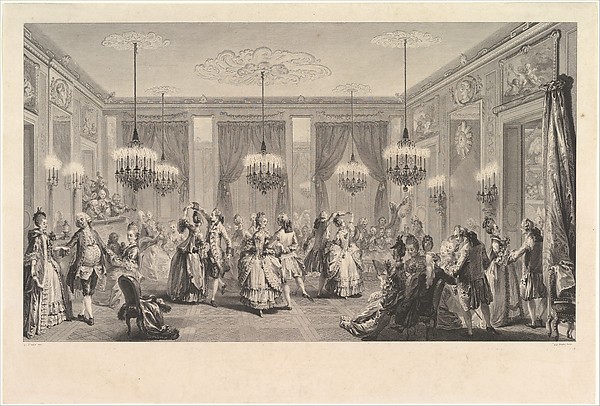
** I'm not quite sure how to translate this one - I know that paré frequently means "dressed" in the sense of "fully-dressed" or "dressed to be seen". The women in the print below are dressed well, but not in robes parées

Le Bal Paré, Antoine Jean Duclos, 1774; MMA 33.56.33
More aboutGalerie des Modes, 34e Cahier bis, 5e Figure

Galerie des Modes, 40e Cahier, 5e Figure

Posted by Unknown

Robe a l'Anglaise, amadis sleeves, the waist tightened with a Levite belt, the petticoat worn over a bouffante. (1782)


This plate is from the Museum of Fine Arts Boston, 44.1542.
More aboutGalerie des Modes, 40e Cahier, 5e Figure

Galerie des Modes, 40e Cahier, 4e Figure

Posted by Unknown

Levite of pink satin trimmed with piping and white lozenges, the Trim of the petticoat is in drapery with Lozenges, the Scarf worn as a baldric, the Coiffure is a crested Pouf belted with a doubled narrow ribbon and adorned with flowers. (1782)

 Gloves. - "Gloves did not cease to be an indispensable accessory of the toilette. Abbe Jaubert, in his Dictionnaire, notes (1773) that "one wears them in all seasons and women above all can hardly do without them."  He enumerates the types of leather from which they are made: chamois, goat, sheep, lamb, suede, deer, elk, etc. and which never hinders the industry of silk, thread, wool, or cotton gloves, that are done as a trade,* nor that of gloves of velvet, satin, taffeta, linen, and other fabrics.

"The types of gloves are as varied as their materials.  There are the furred, the glazed, the perfumed; there are also embroidered ones, where the junction of the fingers, the perimeter of the neck of the thumb, the edge of the top and nearly all the seams are embroidered with thread, silk, gold, or silver."

* I believe this refers to knitted gloves, probably made on knitting machines.  "Thread" is often used in English sources to mean linen yarn, eg. "thread stockings".
More aboutGalerie des Modes, 40e Cahier, 4e Figure

Galerie des Modes, 40e Cahier, 1ere Figure

Posted by Unknown

[The 38th and 39th books are coiffures, and are not in the Bunka Gakuen text.  I believe I will come back again and do all of the hat/hairstyle plates after I finish with the dress plates.]

Adjusted lévite, trained like the robes à l'Anglaise.  Coiffure a large round hat on a toque that is low in front, a single curl in front and four hanging on the Chignon. (1782)

"Merchants put up on their signs English shops.  The lemonade sellers, on the windows of their cafés, announce their punch in the English language.  London redingotes, with their triple collars and their capes which envelop the little masters.  Little boys have their hair round, flat, and without powder.  The father is seen exiting his hotel, dressed in thick wool, trotting in English fashion, the back curved.  It has been a long time that women have been coiffed with elegant hats, whose fashion came to us from the banks of the Thames.  Those racetracks established at Vincennes recall those at Newmarket.  Finally, we have scenes from Shakespeare which, put into verse by M. Ducis, made the greatest effect.

"Thus we no longer fear our enemies.  Here we are familiar with the forms that we rejected with hauteur and disdain thirty years ago.  But have we taken what was best?  Does it not remain to us to adopt every other thing than punch, jockeys, and the scenes of the great Shakespeare?"

Sébastien MERCIER, Tableau de Paris, edit. 1783


More aboutGalerie des Modes, 40e Cahier, 1ere Figure

Galerie des Modes, 37e Cahier, 6e Figure

Posted by Unknown

Pelisse lévite with cuffs and Collar trimmed with ermine, the petticoat of spotted white Satin, the muff of the same trimmed with bands of ermine, and the Belt also of ermine, the Pouf surmounted with batiste flowers and plumes.  This Gown was worn by a Lady of quality during the Mourning for M. Thérèse of Austria, mother of the Emperor and the Queen of France. (1781)

This plate is from the Museum of Fine Arts Boston, 44.1524.
More aboutGalerie des Modes, 37e Cahier, 6e Figure

Galerie des Modes, 35e Cahier, 2e Figure

Posted by Unknown

This figure is dressed in a Lévite fitted à l'Anglaise with little pleats around the waist.  The Coiffure is a coiffure à l'enfance. (1780)

"The farthingales of our mothers, their slashed and flounced fabrics, their ridiculous epaulettes, their pregnant minds[?], this multitude of sleeves of which some resembled veritable poultices[?], all have disappeared, except the excessive height of their coiffures: ridicule could not correct this recent custom: but this defect is tempered by taste and grace which reside in the structure of the elegant edifice.  Women, all things considered, are better set-up today than they have ever been: their outfits unite lightness, decency, coolness, and grace.  These gowns of a light fabric renew themselves more often then gowns which shine with gold and silver; they follow, as it were, the nuances of the flowers of various seasons.  They need only the hand of our marchandes de modes to change them with a so prodigious diversity of gauze, linen, and ribbons."

- Sebastien MERCIER, Tableau de Paris, édit. 1783


More aboutGalerie des Modes, 35e Cahier, 2e Figure

Galerie des Modes, 33e Cahier, 5e Figure

Posted by Unknown


Lévite simple vue par derrière, coeffure negligée ou grand bonnet à la paysanne avec des barbes.

Simple lévite seen from the back; negligée coiffure, or large cap à la paysanne with lappets. (1780)


This plate is from the Museum of Fine Arts Boston, 44.1495.
More aboutGalerie des Modes, 33e Cahier, 5e Figure

Galerie des Modes, 33e Cahier, 1ere Figure

Posted by Unknown

Taffeta lévite, fitted and trimmed with gauze around it; fashionable belt.  The woman is coiffed with a Spa hat.  The dancing master in an informal suit in the fashionable color, and coiffed en herisson. (1780)

The times are no more when one was obliged to specify on ball invitations: ladies without hoops.  Dancers present themselves in short petticoats and fitted gowns.  Such is the turn-out of this amiable student.  Over her fashionable lévite, simply ornamented with a trim of gauze, she passed a spotted ribbon ending with tassels and fringe in the guise of a belt.  Her arms raise the corners of a light gauze apron.  Collar, equally of gauze, knotted in a bow whose ends, after a charming route, are lost under the parfait contentement.  Coiffure in a racine droite, with three curls on each side, of which one is fashionable and falling.  Spa hat, pulled up as a tricorn and surmounted with three plumes which fall softly over the coiffure.  Ribbon bows on the low-heeled shoes.

The young dancing master reveals all the grace of his presence through a simple but elegant suit, whose whole severity is relieved by the manchettes and the discreet lace jabot.  He has untied the ribbon of his cumbersome sword and has unceremoniously propped it against the chair which holds his little hat.  This imitator of Marcel in the art of teaching the minuet, the gavotte, and the passepied seems to speak like him to his docile and graceful student: one jumps abroad, but one only dances in Paris.

More aboutGalerie des Modes, 33e Cahier, 1ere Figure

Galerie des Modes, 32e Cahier, 1ere Figure

Posted by Unknown

Young Lady carrying her child in a Cradle to breastfeed while walking.  She is dressed in a Lévite whose Collar is painted all around and trimmed with Gauze, as are the parements of the Sleeves.  (1780)


More aboutGalerie des Modes, 32e Cahier, 1ere Figure

Galerie des Modes, 31e Cahier, 4e Figure

Posted by Unknown

This Woman is dressed in a fitted Levite, Belted with a white Scarf, she has a Muslin Apron with a large volant, called à la Gouvernante.  Hat of tinted straw, trimmed with Plumes. (1780)

PLAIN LEVITE, covered with an apron à la gouvernante.  Scarf or belt knotted in a chain.  Kerchief of Italian gauze, placed en cravate, forming a désespoir.

Hairstyle à la réforme, that is to say, very low in the front.  This fashion was pushed, all of a sudden, to excess; Women seemed to have passed the word to abdicate the grand Coiffures; but this revolution was too extreme to hope for a long reign: scarcely three months are passed since its first appearance, then it was dismissed.


More aboutGalerie des Modes, 31e Cahier, 4e Figure

Galerie des Modes, 31e Cahier, 2e Figure

Posted by Unknown

New Levite of plain Taffeta, with amadis sleeves, the Trim in striped Gauze. (1780)

LÉVITE A PAREMENT.  The bodice closed, held in with a bow.  Sabot cuffs à la Bayard,* with bows at the join of the arm: these are the most gallant of all the sabots.  Amadises matching the petticoat;** very large parement on the Gown, and trimmed en piedouche; the volant sewn, uniform with the parement.

Non-busquée belt, bell-cord style, ending with gold tassels, tufted with sequins in diverse colors.

Coiffure à la Cybele,†† with a ribbon bandeau, pinched and held in with a star of brilliants; a tuft of flowers coming out of the bandeau.

* Possibly a reference to the Chevalier de Bayard (1473-1524), le chevalier sans peur et sans reproche; there is something historicizing about the cuffs.
** The colorist should have made the lower half of the sleeves green.
† "in pedestal style", referring to the way the parements are the same size the whole way down (unlike those of the robe parée)
†† An Anatolian goddess, assimilated into Greek mythology as an exotic goddess with an ecstatic following, and associated with the fertility of nature.


More aboutGalerie des Modes, 31e Cahier, 2e Figure

Galerie des Modes, 29e Cahier, 1ere Figure

Posted by Unknown

Woman dressed in a plain Lévite edged with a band of pleated Gauze; the Belt in the latest fashion, of spotted ribbon, with knots and fringe at the end; she is coiffed with a turban or toque à la Levantine pulled up with Pearls and surmounted with plumes in panaches on a half-négligée and very relaxed hairstyle. (1780)

LÉVITE A LA DÉVOTE, the bodice closed very high, with a bow matching the belt, from which the collar escapes, almost entirely covering the chest.  Volant uniform with the petticoat; belt tied in a bow, trimmed with a headed fringe called à la JuiveParement of the sleeve en bottes.  Hairstyle low and loose, underneath a Levantine toque, shaded by a panache with four branches, accompanied by an aigrette of heron feathers.

The Man who holds the lorgnette is dressed in an Overcoat trimmed with wood buttons worked in marquetry, very light and very unique.  Round wig à la Jokeis; hat, buttoned in the back; cow-nose shoes, following the ancient fashion, favorable for gouty feet.

The other figure, pressing his lips to a hand which is slipping him a billet-doux, is dressed in a deshabillé or overcoat edged de systéme, in a double row on the pockets.  Vest and breeches matching the Suit; hair à l'espoir with a finger curl.


More aboutGalerie des Modes, 29e Cahier, 1ere Figure

Galerie des Modes, 28e Cahier, 2e Figure

Posted by Unknown

Another Lévite, the petticoat of a different color, the sleeves of the color of the petticoat.  The Lévite like the Circassienne, having only mancherons: in place of a scarf, a ribbon belt.  This figure is coiffed with a fashionable black hat. (1780)

LÉVITE PARÉEBodice with mancherons, the collar forming revers, erupting from the belt; underbodice en fourreau, closing in front, amadis sleeves, with parement à la cavaliere.  The bottom of the petticoat trimmed with a volant, which is headed with a large ribbon.  Flat belt, ending in fringe, tied over the Lévite.  The belt, the collar, the parement, and the head of the volant in the same color.

Green monkey, which has become rather common in Paris for some years, gamboling to catch a pomegranate.


More aboutGalerie des Modes, 28e Cahier, 2e Figure

Galerie des Modes, 28e Cahier, 1ere Figure

Posted by Unknown

Lévite outfit trimmed with tassels, epaulettes, and cords: the matching petticoat bordered with a band of a different color, a blonde lace on the edges of the Lévite and two sides of the petticoat trimming.  The hat is of white gauze, and trimmed en pouf with black gauze, belted with black lace and a colored ribbon. (1780)

LÉVITE A PRÉTENTION.  The bodice and the front of the petticoat decorated with oval buttons and tassels placed in garlands.  Collar with revers, sleeves with epaulettes and parements.  The Gown tied with tassels on the chest: the stomacher decorated with cord; the belt in drapery, placed under the Gown.

Platitude in the hand, conforming to fashion.  Thus are called the very flat snuffboxes which were very well received by all men and women who take snuff.


More aboutGalerie des Modes, 28e Cahier, 1ere Figure

Galerie des Modes, 27e Cahier, 6e Figure

Posted by Unknown

Lévite trimmed with brandenburgs and cords in a sharp color on the parements and on the ground of the gown; the flat trimming of the petticoat is in the color of the brandenburgs.  This figure is coiffed with a Devonshire hat, or Spa hat: this fashion was brought from this city to the Court of France, and was brought there by Mme. Devonshire. (1779)


LÉVITE A LA PRUSSIENNE.  The Gown and the petticoat trimmed with brandenburgs.  Belt in drapery over the Gown, busquée in front,* to free the waist and give it grace.  Sleeves and parements à la cavaliere, opening underneath, following the ancient method abandoned by the Military, because it was inconvenient and because the Minister recognized that it was not economical.

The collar, the parement, the belt, the trimming, and the volant, of a sharp color different from that of the Gown.  Spa hat, seen from the front.  See the third Figure of the following Book, where this hat is shown from another point of view.

* Busquer hasn't turned up recently.  I need to go back and look at the previous uses and Heileen's comments, but this is more explicit in suggesting a downward-pointing curve at the waist


More aboutGalerie des Modes, 27e Cahier, 6e Figure

Galerie des Modes, 23e Cahier, 4e Figure

Posted by Unknown

Robe à la Lévite with bodice en fourreau, petticoat coupé with flat trim in the color of the gown;* demi-négligée coiffure called à la Picarde, with Italian gauze lappets scalloped with lace. (1779)


ROBE A LA LÉVITE, degraded of its honors.  A young girl, supervised by her mama, never has what she desires.  The one shown in the Print, and who, until best, amuses herself in giving pastilles to her dog, can provide proof.  She has obtained from her mother a Robe à la Lévite; simple, plain, truthful; but it is still a Lévite.  It only lacks a bagatelle to complete the outfit: a belt and a hat.  The inexorable mama has pretended that it was her duty to mitigate a Dress which seemed too galant.**  It was necessary to obey and to be contented with a very bourgeois medium cap, capable only of making the rest of the dress ridiculous, if it were not given to the Youth to embellish all that is around her.

* I believe this means that the body of the petticoat is meant to be a different color, which shows better in the print below.
** Galant is used frequently in the fashion plates, sometimes to mean "gallant", but sometimes more like "pejoratively sexy".


More aboutGalerie des Modes, 23e Cahier, 4e Figure

Galerie des Modes, 21e Cahier, 3e Figure

Posted by Unknown

Levite, with two pleats in the back, regular, stopped at the waist with a scarf that ends in tassels.  Coiffure: a straw hat trimmed with gauze en pouf, trimmed with flowers. (1779)


ROBE A LA LÉVITE.  This is again one of the noble Gowns that the desire to ban constraint all in clothes caused to be adopted: the first idea for it is due to the Outfits created for the Actresses of the Théatre Française, when it put on the Tragedy of Athalie, with the Chorus.  These Clothes, modeled on those of the Levites and the Priests, consisted of a type of Aube, with a stole which crossed it in front.  This costume was entrenched in those worn by Priests; the stole changed into a belt, and soon it became a fashionable Dress.

Such were the first Levites; they were worn first plain, without panniers or bouffantes; but with time, they were stripped of this original simplicity, such that one will have occasion to notice it thereafter.  To the notice which is found at the bottom of the Print, being sufficient to give an idea of the costume, we add only a word on the shoe, that the position of the Figure doesn't permit to be shown entirely.  It is a shoe à la Lévite; it has neither buckles, nor rosettes, and attaches with a gance, which is tied under a parement folded back over the foot, and which has the same shape and color as the sleeve parement, thus the shoe matches the Gown.


More aboutGalerie des Modes, 21e Cahier, 3e Figure