Showing posts with label portrait analysis. Show all posts

Painting Costume Analysis: Pamela Series, Part Twelve

Posted by Unknown

XII: Pamela Tells A Nursery Tale, Joseph Highmore, 1743-4; Fitzwilliam Museum M.Add.9

The whole story ends, of course, with Pamela a loving mother. Her views on child-raising are fairly sensible and modern: she insists on nursing her infants herself, she is against swaddling, and she believes that girls should be educated.

This specific scene is described in letter 113, in the fourth volume.
Miss Goodwin imagine you see on my right hand, sitting on a velvet stool, because she is eldest, and a Miss: Billy on my left, in a little cane elbow chair, because he is eldest, and a good boy: My Davers, and my sparkling-eyed Pamela, with my Charley between them, on little silken cushions at my feet, hand-in-hand, their pleased eyes looking up to my more delighted ones, and my sweet-natured promising Jemmy in my lap; the nurses and the cradle just behind us, and the nursery-maids delightedly performing some useful needle-work, for the dear charmers of my heart.


In the last painting in the series, Pamela is once again dressed in light blue, a color which has strong associations with the Madonna - appropriate for the scene. Her sleeves are wide, with no cuffs, and she may not be wearing a hoop. Her cap is of the more concealing type, but the ears are pinned up; her kerchief is translucent, and has a ruffle around the edge. Only the top of Jemmy's head can be seen.


Billy seems to have been breeched, and is wearing a red coat with a cravat over a black waistcoat. His hair is powdered and tied back in an adult style. Meanwhile, Davers's hair is loose and fairly short (as well as unpowdered), and he is wearing a white gown, as are Pamela and Charley, who have switched places for the purpose of composition. The top of little Pamela's hair is covered with a pink-ribboned cap in a woman's style, while Charley's head is firmly encased in a baby's cap with a blue bow.


Miss Goodwin - Mr. B's illegitimate daughter, if you remember - is, like Billy, in adult dress. Her gold taffeta gown has ivory/pale yellow cuffs and robins, and her cap (shaped like little Pamela's) has what looks to be a blue flower on it. I believe there is a tucker around her neckline.


The children's nurses are very well-dressed, in gold and blue taffeta. One nurse's cap is pinned up, the other's is not. Both are wearing opaque kerchiefs, but possibly no aprons.


The nursery-maid in the back, sewing linen for the children, may also be wearing gold taffeta. She also has an apron, a kerchief, and a cap that is fastened under her chin. In some ways, this maid brings the story in the paintings around full circle, to Pamela's original position in Mr. B's mother's household.
More about → Painting Costume Analysis: Pamela Series, Part Twelve

Painting Costume Analysis: Pamela Series, Part Eleven

Posted by Unknown


XI: Pamela Asks Sir Jacob Swinford's Blessing, Joseph Highmore, 1743-4; Tate Collection N03576

Eventually, after recounting the events of the last painting in great detail to Mr. B, the two go home and fail to confront Lady Davers due to Pamela's avoidant behavior. But they do finally converse, and Mr. B makes it clear that he is truly married to Pamela and that he doesn't feel he's done anything to shame his family. They reconcile somewhat, but Lady Davers still makes a fuss over eating with Pamela. After eating the scene shifts to the garden, where Mr. B explains his part in a duel where the other man died (but not because of his actions) and his past with a Sally Godfrey (a sexual conquest), and Lady Davers finally gives in to Pamela's goodness.

Here's an interesting tidbit of everyday life for writers: when they eat dinner - the midday meal in this context - they're described as calling for "the cloth" to be laid in the parlor. And I note that while Lady Davers calls her maid "Beck" when she is an antagonist, once she is nicer to Pamela she calls her the more respectful "Mrs. Worden".


Mr. B then embarks on a tangent about why the upper classes grow up to be haughty and have bad tempers, and gives Pamela a description what conduct he expects from his wife, which she turns into a numbered list of forty-eight(!) items. Which is interesting if only as a look at the historical context.

The neighbors come around and everyone celebrates. Pamela distributes money to the servants, including five guineas to Mrs. Worden "for a pair of gloves", and the two leave for their primary estate. Once there, they speak with and accept the congratulations of all of the servants in turn, especially the ones that were originally dismissed for taking Pamela's side against their employer. Mr. B then gives her "possession of my lady's dressing room and cabinet, and her fine repeating-watch and equipage; and, in short, of a complete set of diamonds, that were his good mother's; as also of the two pair of diamond earrings, the two diamond rings, and diamond necklace, he mentioned in his naughty articles ..."

Pamela really gets into the tide of fashion at her husband's request.
I had a good deal of employment in choosing patterns for my new clothes. He thought nothing too good; but I thought everything I saw was; and he was so kind as to pick out six of the richest for me to choose three suits out of, saying, We would furnish ourselves with more in town, when we went thither. One was white, flowered with silver most richly; and he was pleased to say, that, as a bride, I should make my appearance in that the following Sunday. And so we shall have in two or three days, from several places, nothing but mantua-makers and tailors at work. ... He also made me choose some very fine laces and linen; and has sent a message on purpose, with his orders, to hasten all down, what can be done in town, as the millinery matters, etc. to be completed there ...
She also has a servant buy "good linen" and suits of "the finest cloth" for her father and of "creditable silk" for her mother to wear at their new Kentish farm. The myth that Victoria invented or popularized the white wedding dress has irritated me for a long while, and so I'm somewhat gratified to find such a strong connection between white gowns and brides in Pamela - she wears white satin to her own wedding, and then continues to wear white afterwards.

A group of rakes pays them a visit, and then a group of schoolgirls. One of the schoolgirls, a Miss Goodwin, is actually the natural daughter of Mr. B and Sally Godfrey, but is considered to be his niece by everyone else for the sake of propriety. After Sally gave birth, she went to Jamaica with some money from Mr. B and married well.

On Sunday, the two go to church.
I was dressed in the suit I mentioned, of white flowered with silver, and a rich headdress, and the diamond necklace, earrings, etc. I also mentioned before. And my dear sir, in a fine laced silk waistcoat, of blue paduasoy, and his coat a fine pearl-coloured cloth, with gold buttons and button-holes, and lined with white silk ...
The story ends with Pamela achieving success and friendship among the families near Mr. B's home (and an epilogue the tells the reader exactly what they should learn from the examples of each character). However. The story does go on in another volume, which consists of Pamela's letters to Lady Davers and other friends, but which is not included in my copy.

From looking at copies of the fourth volume on Google Books, I can see that Sir Jacob Swinford is Mr. B's "uncle by the half blood" who is contemptuous towards Pamela for her background - he calls her "Linsey-Woolsey" - and because his son would have been Mr. B's heir if Mr. B had no children. Lady Davers introduces Pamela to him as "Lady Jenny", the unmarried daughter of a local countess, and he is very taken with her. (There's some banter about the size of her hoop being only suitable for married women.) When they reveal the truth, Pamela kneels to him and he accepts her as his niece.


While the actual text would imply that Pamela is meant to be dressed as befitting her station, Highmore chose to dress her down a bit, to emphasize that she is humble and from a working-class background. Her dark blue silk mantua has large cuffs, and fastens with ribbons in the front over a large kerchief. Her cap is the more enveloping sort she wore in earlier episodes, before she was married, and it is accessorized with a blue ribbon.


Sir Jacob is dressed as the text describes him, in an old-fashioned coat, which completely covers his waistcoat and breeches. His wig and his narrow cravat, tied loosely around his neck over his coat, are also unfashionable. He is carrying a cane with a silver top.


I believe this is Mr. B. His coat is a brown - probably wool - cloth, heavily "laced" with silver. His hair or wig is lightly powdered, and the queue is encased in a black silk bag.


The figures in the background are difficult to make out in much detail. One of the women is in a beige mantua, possibly decorated with gold lace, which ties, like Pamela's, over a kerchief with blue ribbons. The other woman is in pink silk, with some sort of dark tippet around her neck. Both women wear smaller caps.

One of the men wears a black coat and a longer wig; he may be a clergyman. The other wears a blue coat and completely unpowdered hair.
More about → Painting Costume Analysis: Pamela Series, Part Eleven

Painting Costume Analysis: Pamela Series, Part Ten

Posted by Unknown

X: Pamela and Lady Davers, Joseph Highmore, 1743-4; National Gallery of Victoria 1117-3

One would think that Pamela's troubles would be over after her marriage: after all, most of her problems stemmed from her "courtship". However, Mr. B's family is still a hurdle to get over. His sister, Lady Davers, does not approve of Pamela's entry into their ranks and is convinced that Mr. B has only pretended to marry Pamela in order to get her into bed, anyway.

In the pictured scene, Mr. B has been away with a sick friend for some time, and has asked Pamela to meet him that afternoon at a different friend's house. Unfortunately, Lady Davers arrives with her nephew, "Jackey", and maid, Becks, and pins her up in a parlor. Every time Pamela tries to leave, one of them puts a chair in front of the door and sits in it. (This happens half a dozen times.) Pamela pleads that she has a "pre-engagement" and shows Lady Davers Mr. B's letter asking for her, but Lady Davers accuses her of putting on airs and repeatedly calls her a creature and a wench. At last, Pamela calls to the coachman out the window to have the carriage made ready, and jumps out the window herself to run into it.


Pamela, now a respectable wife, is dressed in a beige silk gown with an unadorned white stomacher. She has a tucker sewn into the neckline, and ruffles on her shift sleeves, as usual, and she has returned to her smaller cap. The main additions to her wardrobe are jewelry: she now has a small black (lace?) choker with perhaps a tiny pendant, and a much thicker black silk necklace with a larger pendant on the end.


Lady Davers, restraining Pamela with a nasty look on her face, is dressed in a more markedly wealthy way. For one thing, she is wearing a sacque, which at that time was just coming into fashion in England. The sacque's cuffs and robings are made out of a heavily brocaded fabric that looks like it might even use metallic threads. Her cap is very much like Pamela's, as are her ruffles and tucker, but her hair is powdered and she appears to have a fur tippet wrapped around her neck.

Jackey almost looks like a child behind her, but I believe he is meant to be a bit older than Pamela (who is 16). There is something about the pairing of blue fabric for his coat and gold braid for trim that makes him almost appear to be in livery. His hair also seems to be lightly powdered.


Mrs. Jewkes has been somewhat redeemed in the text at this point, and treats Pamela with the respect she deserves. When Lady Davers asks for a table and chairs to be brought in so she and Jackey can eat, Mrs. Jewkes makes sure a third chair is added for Pamela (although Lady Davers refuses to allow her to be seated, due to her determination that Pamela is her brother's mistress). Perhaps relating to her change of moral position, Mrs. Jewkes is also dressed more respectably, in a black gown with a kerchief covering the stomacher, and a long white apron. Her cap was previously usually worn with the "ears" pinned up, but now they are tied firmly under her chin.

Becks cannot be seen well behind Mrs. Jewkes. Fitting to her position as a lady's maid rather than a housekeeper, she is wearing a pink silk gown and a cap with no ears.


And just visible behind Pamela's arm is Jonathan, the coachman, in a black cocked hat.

More about → Painting Costume Analysis: Pamela Series, Part Ten

Painting Costume Analysis: Pamela Series, Part Nine

Posted by Unknown

IX: Pamela is Married, Joseph Highmore, 1743-4; Tate Collection N03575

Because Mr. B really isn't supposed to marry Pamela, they need to hide their relationship for a while. He asks her to "dress as [she] used to do; for now, at least ...", which I believe means as she dressed when she was working for his mother, before she decided to retreat back into homespun to prove her virtue. She then goes back to her room and changes her outfit completely:
... and so put on fine linen, silk shoes, and fine white cotton stockings, a fine quilted coat, a delicate green Mantea silk gown and coat, a French necklace, and a laced cambric handkerchief, and clean gloves; and, taking my fan in my hand, I, like a little proud hussy, looking in the glass, and thought myself a gentlewoman once more ...

When she returns, she is in fact so radiant that her father doesn't recognize her, and suspects for a moment that Mr. B is just making fun of Pamela and is actually marrying "some fine lady". They all get in the carriage to drive off - Mr. B letting the other two sit "foreside" while he has his back to the horses, which is very polite of him - to make up with Mr. Williams (the chaplain, who was out of the story for pages and pages) and bring him back for dinner. Mr. B continues in his kindness to Pamela's father by giving him some clothing to wear at chapel the next day:
He carried him up the stairs, and shewed him several suits, and would have had him take his choice. ... And, my good master, at last, (he fixed his eye upon a fine drab, which he thought looked the plainest,) would help him try the coat and waistcoat on himself; and, indeed, one would not have thought it, because my master is taller, and rather plumper, as I thought but, as I saw afterwards, they fitted him very well. And being plain, and lined with the same colour, and made for travelling in a coach, pleased my poor father much. He gave him the whole suit, and, calling up Mrs. Jewkes, said, Let these clothes be well aired against tomorrow morning. ... He was then pleased to give him the silver buckles out of his own shoes.
After Sunday chapel the next morning, they sit down to dinner, Pamela noting that she is dressed in "a flowered satin, that was my lady's, and looked quite fresh and good, and which was given me, at first, by my master; and the ladies, who had not seen me out of my homespun before, made me abundance of fine compliments, as soon as they saw me first." There follows a very long conversation on psalms, and then a long conversation about when Pamela will fix the secret wedding date (in which nothing is decided anyway, but a while later she picks that Thursday).

When Mr. Andrews leaves for the family home, he tells Pamela that he will not "be seen in [his new clothes] in his neighborhood, till I was actually known, by every body, to be married; nor would he lay out any part of the twenty guineas [that Mr. B gave him for clothes for himself and his wife] till then neither, for fear of reflections" - Pamela's situation is still precarious, and extremely open to misinterpretation. Until she's actually married, any advantages that she or her family get from Mr. B look mainly like payment for prostitution to their contemporaries.

Pamela spends the first half of the week going for drives and talking with Mr. B, and in reflecting at length on what her conduct should be. Her low position preys frequently on her mind: his sister, Lady Davers, is still very much opposed to the match, and Pamela is also bothered by the fact that she brings nothing to the marriage and there are no documents to be signed about properties and settlements.

On Thursday morning, after a sleepless night, she is dressed and goes out with Mr. B, Mr. Williams, Mrs. Jewkes, and Mr. Peters on the pretense of looking at the chapel. Mr. Williams performs the service, the maid Nan watches at the door, and the others act as witnesses. Once the marriage has taken place, Mrs. Jewkes brings out "a large silver tumbler, filled with sack, and a toast, and nutmeg, and sugar," and Mr. Williams is given a living and a £50 note. A happily ever after, about 65% of the way through the book!


Although Pamela's wardrobe is usually described in detail, her wedding outfit is described only as "a rich white satin night-gown, that had been my good lady's, and my best head-clothes, etc." The gown does have a satiny sheen, although it looks more ivory than white here. Interestingly, her cap is the more old-fashioned/working-class style than the one she wore to meet her father. Is this a choice on the part of the artist to make her appear more modest, a close interpretation of the text (as she was pretending not to be going to her wedding), or a reflection of contemporary habits?

She also has on a pair of satin gloves, a long apron, and a kerchief held in place by a satin band.


As usual, Mr. B's suit matches entirely, each piece being dark blue. It is relatively plain, compared to some of the outfits he's worn in the Pamela paintings - the only trim is a border of some darker blue, possibly a wide silk braid or a damasked silk. His stockings are pulled up over the bottom of his breeches. His hair is lightly powdered and pulled back into a queue, with a curl on either side of his face.
More about → Painting Costume Analysis: Pamela Series, Part Nine

Painting Costume Analysis: Pamela Series, Part Eight

Posted by Unknown

VIII: Pamela greets her father, Joseph Highmore, 1743-4; National Gallery of Victoria 1116-3

Driven to a frenzy, Mr. B attempts to find any letters to her family that Pamela has secreted on her person, asking if they are inside her stays or pockets and threatening to strip her; he starts to unpin her handkerchief and then to check her garters, but then allows her, due to her begging and crying, to go up to her bedroom and bring them down.  She writes him a note to give her until the next day, then sits down and unstitches them from her underpetticoat.

As he reads them, Mr. B finally says that she can go home to her family - but while traveling back, Pamela realizes that she is in love with her captor, and is given a letter where Mr. B confesses his own love and asks her to come back to marry him.  Are we surprised when she does?


Mrs. Jewkes comes out with "her clothes huddled on" and tells Pamela that Mr. B is ill; Pamela's return of course brings about an improvement in his condition, and when he is well he pulls out a letter case and shows her a note from Lady Davers, his sister.  To summarize it: it is wrong for him to turn their mother's favorite maid into a kept woman, and it is also wrong for him to create an unequal match for himself and bring a servant girl into their ancient family.

In preparing to go out with Mr. B in his carriage, she considers putting on her "best silk nightgown", but in the end, both of them wish her to keep wearing her maid's clothing - it represents simplicity, a lack of guile and artifice.
I will beg of you, sir, not to let me go very fine in dress; but appear only so, as that you may not be ashamed of it after the honour I shall have of being called by your worthy name: for well I know, sir, that nothing so much excites the envy of my own sex, as seeing a person above them in appearance, and in dress.
and
I am obliged to you, Pamela, said he, and pray be only dressed as you are; for [the two young women who are curious about her] know your condition, and I have told them the story of your present dress, and how you came by it, one of the young ladies begs it as a favour, that they may see you just as you are: and I am the rather pleased that it should be so, because they will perceive you owe nothing to dress, but make a much better figure with your own native stock of loveliness, than the greatest ladies arrayed in the most splendid attire, and adorned with the most glittering jewels.
They discuss what her place could be in society and in his household, and she asserts that she will not mind any barbs aimed by great ladies, and she will simply be the mistress of his house, doing the accounts and making "all the fine linen of it for yourself and me".  Later, he asks if she wants to order "clothes against her marriage", and she leaves it up to him, asking that they not be "too fine".

They are visited by a few of the local gentry, Pamela is "not dressed in some of my best clothes" despite the previously-mentioned young ladies being "dressed in their best attire".  There is much talk of how charming Pamela is in her plain dress, they drink a few glasses of sack, and it is remarked that she will "adorn ... her distinction".  There is a knock at the door, and a servant tells Mrs. B - Pamela's father is admitted!  He, like Pamela, is humble and doesn't wish to appear in company, but he is brought in and the pictured scene occurs.

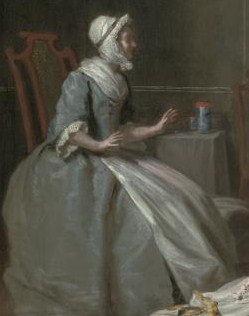
In the painting, Pamela is dressed in a grey silk gown, rather than the humble homespun she is described as wearing in the book. One can only speculate on why the artist prefers to show Pamela dressed well - my guess would be that the idea of the humbly-dressed and pure young woman comes across very well as an ideal, but that Pamela painted in her brown gown is not as arresting or noticeable a figure as Pamela in a lighter, shiny silk gown. Additionally, she has a small cap on the top of her head, rather than the larger, more enveloping cap associated with her servants' dress, as well as muslin ruffles on her shift sleeves and a small muslin tucker.


Mr. B is dressed very well, in a grey that complements Pamela's gown. His silk coat is heavily trimmed with silver lace. Only a sliver of his waistcoat can be seen, but it seems to be white or a lighter grey; his breeches are black.

His pose - hand inside his coat - is of course most closely associated with Napoleon Bonaparte, but was very common for well-bred men in portraiture.


Mr. Andrews is dressed in brown, probably wool, like Pamela's old gown. His stockings appear to be either a natural mix of wool or very dirty; his cravat is simply tied once and allowed to hang down the front of his coat. And his hair is, of course, long and unpowdered (but greying).

I knew the voice, and, lifting up my eyes, and seeing my father, gave a spring, overturned the table, without regard to the company, and threw myself at his feet.
The company behind the abandoned card table is dressed very well, but do not look like they are portrayed sympathetically. There is a man in an old-fashioned long wig and a brown silk suit trimmed with gold lace, holding his cards and looking down his nose at the goings-on. Next to him, with a pinched expression on her face, is a woman in a blue gown. Her cap is closer to a turban than an ordinary pinner cap, and her kerchief is untucked from her gown on one side. Around her neck she is also wearing a black bouffant, which is tucked into a silver/grey band holding the front of her gown together. I believe there is a chatelaine or some sort of bauble at her waist.
More about → Painting Costume Analysis: Pamela Series, Part Eight

Painting Costume Analysis: Pamela Series, Part Seven

Posted by Unknown

VII: Pamela in the Bedroom with Mrs Jewkes and Mr B., Joseph Highmore, 1743-4; TC N03574
This scene is similar to Mr. B's last nighttime attack on Pamela's virtue.  However, while Mrs. Jervis was a somewhat unwitting participant - truly believing in her employer's good intentions - Mrs. Jewkes takes on a more active role.  She dresses Mr. B in a maid's clothing, has him pretend to be asleep in the corner, and then encourages Pamela to take her own clothes off so she can get in bed ... and be ravished by Mr. B.  (The attempt fails.)

Pamela's shift is arrayed artistically over her torso, but I believe she is still in an underpetticoat, as there is a tightness around her waist that indicates a waistband.  Her stockings are held up with pink garters, and there is a blue ribbon around her cap - the same cap she wore in part six, but with the ribbon in a different configuration.  Her black leather shoes fasten with buckles, rather than tying.  The blue silk gown on the nearby chair is probably hers.

Mrs. Jewkes's nightwear is mostly covered, but we can see that there are no ruffles at her elbows.  Her nightcap covers her hair, much more than the cap she wore during the day in part six.

Mr. B's costume resembles what Pamela wore in part four: a brown gown with white apron and kerchief, and ruffles on his shift sleeves.

More about → Painting Costume Analysis: Pamela Series, Part Seven

Painting Costume Analysis: Pamela Series, Part Six

Posted by Unknown

VI: Pamela Shows Mr. Williams A Hiding Place For Their Letters, Joseph Highmore, 1743-4; Fitzwilliam Museum M.Add.8

When Pamela got into Mr. B's carriage, she thought she would be taken to her parents' house, but in fact she was driven to Mr. B's other estate in Lincolnshire.  Before she was under the chaperonage of Mrs. Jervis, who was respectable but sometimes rather dim about Mr. B and his attentions, but in Lincolnshire she was watched by Mrs. Jewkes, a thoroughly disrespectable bawd who hits and insults Pamela.  Pamela's one comfort, apart from writing letters to give to her parents someday when she is free, is Mr. Williams, a local clergyman.  They communicate secretly by hiding letters under a sunflower, which Pamela is pointing to in the painting.

There are very few clothing/sewing-related lines in this section apart from Mrs. Jewkes's method of keeping Pamela inside (she takes her shoes) and the following passage:
So I went towards the pond, the maid following me, and dropt purposely my hussy: and when I came near the tiles, I said, Mrs Anne, I have dropt my hussy; be so kind as to look for it; I had it by the pond side.
While "hussy" had at this time the derogatory meaning we associate with it today, it's derived from the word "housewife" - it seems like the neutral sense may have lasted longer as a diminutive to describe housewife sewing cases.


Our heroine is still wearing her demurer cap with ruffled lappets meeting under her chin.  Over it, she has a straw hat.  At first glance, it looks like the dark blue ribbon is a part of the cap, but on looking back at Pamela Preparing to Go Home, it seems much more likely that the ribbon is holding the hat to her head.

Pamela is now wearing the gown she had on in the summerhouse, I think, or one much like it.  I didn't notice a change of clothes in the text; it's possible that the painter simply got bored of the brown gown, or made a deliberate choice to have Pamela appear clearly as a lady and not a maid.  It is off-white or pale pink silk taffeta, with wide, cuffed sleeves, with a blue silk petticoat.  It fastens over the kerchief with a light blue ribbon.  Over the gown, she has a long, sheer apron - it's not a working apron.

Her shift sleeves have two crisp ruffles on each, and she is also wearing plain white mitts.


Mrs. Jewkes is a very different story.  The most noticeable thing about her appearance is that she is not wearing stays: this is an immediate hint to a viewer who hasn't read the book that she is not respectable and is not a good character.  Her brown dress is also in contrast to Pamela's pale one, another hint to her lack of virtue and Pamela's purity.  The skirt of her gown trails on the ground, where it looks crumpled, while Pamela's gown doesn't touch the floor.

Because she's facing the other way, messing with a hedge, it's hard to see more details of her gown.  But we can still see that she has ruffles on her shift, a kerchief that isn't tucked in (at least in the back), and a long apron of her own.  Her cap looks awkward, perhaps because it is too small, and her lappets are pinned up.


I've never spent much time on clerical dress, but fortunately while translating L'Art de la Lingere and L'Art du Tailleur (I'm not finished with that one yet) I came across a comparatively large amount of information on it.  Mr. Williams's cassock seems to be about ankle-length, so it is probably what Garsault called a soutanne, rather than a soutanelle, which he said "is distinguished from the lay justaucorps in that it is not separated at the bottom, that is to say, that it is not open at the bottom of the front nor in the back, that it has four pleats only at the sides, and no half-pleat".  It looks as though he's wearing some sort of robe over it, which resembles Garsault's robe de palais; that was said by Garsault to have only been worn by "men of the Court of Justice", but perhaps it was more widely worn before 1771.

Mr. Williams is wearing a bob wig, which was a style very commonly used by the clergy, possibly because it was simple and plain.  Over it, there is a very plain cocked hat.  His white collar was called a rabat, which today in English is a term for a type of clerical waistcoat, so it's one to be careful with.
More about → Painting Costume Analysis: Pamela Series, Part Six

Painting Costume Analysis: Pamela Series, Part Five

Posted by Unknown

V: Pamela Leaves Mr. B's House in Bedfordshire, Joseph Highmore, 1743-4; Fitzwilliam Museum M.Add.7

Finally, finally, Pamela's starts and stops and Mr. B's waylayings result in Pamela climbing into his coach to be driven home.  But Letter XXXII begins with Pamela bewailing her fate, before taking a step back to the time when she thought she was being taken back to her parents.
The long-hoped-for Thursday morning came, when I was to set out ... They all would have made me little presents, as tokens of their love; but I would not take any thing from the lower servants, to be sure.  But Mr. Longman would have me accept of several yard of Holland, and a silver-snuff-box, and a gold ring, which he desired me to keep for his sake; ...
And when Mrs. Jervis told me with a sad heart, the chariot was ready with four horses to it, I was just upon sinking into the ground, though I wanted to be with you.
... But Harry carried my own bundle, my third bundle, as I was used to call it, to the coach ... I looked up when I got to the chariot, and I saw my master at the window, in his gown; ...


Pamela is still dressed in her sad-colored wool gown, although this time you can see the front of it - which looks to me like it's laced over the ends of her muslin kerchief.  And this time it does show her "black silk necklace", too.  The hat she previously carried by its strings is no securely tied down and has a nice curve to it.  While she looks pretty nice, she's still subtly out of place in this carriage.

Robin Coachman is entirely covered by a greatcoat.  Blue was a cheap color, the dye deriving from the common woad plant; it was a common color for servants' livery for this reason.  I would describe his collar and cuffs as drab, a color with several definitions that agree it's a kind of light brown.  He is also wearing a lightly powdered wig, brown leather gloves, and a cocked black hat with gold braid around the edges.

The servants in the background are hard to make out, but the women in front can be seen.  She is dressed much like Pamela, in a plain gown possibly fastened over a kerchief.  Her cap covers her hair much more fully, though, and she may also be wearing a apron.

Mr. B can just be made out at the window, in the same cap he wore when he surprised Pamela in bed, and a reddish-brown morning gown/wrapping gown.
More about → Painting Costume Analysis: Pamela Series, Part Five

Painting Costume Analysis : Pamela Series, Part Four

Posted by Unknown

(For a clothing-related painting, you get a post that is chock-full of clothing-related quotes!)

IV: Pamela Preparing to Go Home, Joseph Highmore, 1743-4; National Gallery of Victoria 1115-3

A little recap: in the first few letters, Mr. B was very generous with his late mother's things.
(Letter VI) My master has been very kind since my last; for he has given me a suit of my late lady's clothes, and half a dozen of her shifts, and six fine handkerchiefs, and three of her cambric aprons, and four holland ones.  The clothes are fine silk, and too rich and too good for me, to be sure.
(Letter VII) Since my last, my master gave me more fine things.  He called me up to my late lady's closet, and, pulling out her drawers, he gave me two suits of fine Flanders laced headclothes, three pairs of fine silk shoes, two hardly the worse, and just fit for me (for my lady had a very little foot,) and the other with wrought silver buckles in them, and several ribands and top-knots of all colors; four pair of white fine cotton stockings, and three pair of fine silk ones; and two pair of rich stays.
Pamela finds accepting the stockings without a chaperone present embarrassing, as they're an intimate gift.  This finery is part of what caused Mrs. Jervis to speculate that Pamela would soon be moving to Mr. B's sister Lady Danvers's house as a lady's maid (as I mentioned previously).  He ruins the good impression he's given by making unwelcome advances to her in the summerhouse.


In her next letter, Pamela starts considering running away, but her clothing proves a problem.
(Letter XII) ... but then I had two miles and a half, and a byway, to the town; and being pretty well dressed, I might come to some harm, almost as bad as what I would run away from; ... O how I wished for my grey russet again, and my poor honest dress, with which you fitted me out, (and hard enough too it was for you to do it!) for going to this place, when I was not twelve years old, in my good lady's days!
She's afraid to tell Mrs. Jervis what happened with their employer, and she eventually asks her if they can share a bed because she's "afraid of spirits".  That night, she gives in and explains, but Mrs. Jervis thinks (wrongly, if you can imagine!) Mr. B will start to feel ashamed of himself soon.  However, he keeps creeping around, telling Mrs. Jervis that Pamela's vain and conceited, and accusing Pamela of being a liar and attacking her.

Through various contrivances, Pamela is kept from going home - she wants to finish embroidering the waistcoat, Mr. B says she has to finish it, etc. - but she does try to get on with it.
(Letter XX) Unknown to Mrs. Jervis, I put a project, as I may call it, in practice.  I thought with myself some days ago, Here I shall go home to my poor father and mother, and have nothing on my back that will be fit for my condition; for how should your poor daughter look with a silk night-gown, silken petticoats, cambric head-clothes, fine holland linen, laced shoes that were my lady's; and fine stockings! And how in a little while must these have looked, like old cast-offs, indeed, and I looked so for wearing them! And people would have said, (for poor folks are envious as well as rich,) See there Goody Andrews's daughter, turned home from her fine place! What a tawdry figure she makes! And how well that garb becomes her poor parents' circumstances! - And how would they look upon me, though I to myself, when they should come to be threadbare and worn out? And how should I look, even if I could purchase homespun clothes, to dwindle into them one by one, as I got them? - May be, an old silk gown, and a linsey-woolsey petticoat, and the like. So, thought I, I had better get myself at once equipped in the dress that will become my condition; and though it may look but poor to what I have been used to wear of late days, yet it will serve me, when I am with you, for a good holiday and Sunday suit, and what, by a blessing on my industry, I may, perhaps, make shift to keep up to.

So, as I was saying, unknown to any body, I bought of farmer Nichols's wife and daughters a good sad-coloured stuff, of their own spinning, enough to make me a gown and two petticoats; and I made robing and facings of a pretty bit of printed calico I had by me.

I had a pretty good camblet quilted coat, that I thought might do tolerably well; and I bought two flannel undercoats; not so good as my swanskin and fine linen ones, but what will keep me warm, if any neighbor should get me to go out to help 'em to milk, now and then, as sometimes I used to do formerly; for I am resolved to do all your good neighbours what kindness I can; and hope to make myself as much beloved about you, as I am here.

I got some pretty good Scotch cloth, and made me, of mornings and nights, when nobody saw me, two shifts; and I have enough left for two shirts, and two shifts, for you my dear father and mother.  When I come home, I'll make them for you, and desire your acceptance.

Then I bought of a pedlar, two pretty enough round-eared caps, a little straw-hat, and a pair of knit mittens, turned up with white calico; and two pair of ordinary blue worsted hose, that make a smartish appearance, with white clocks, I'll assure you; and two yards of black riband for my shift sleeves, and to serve as a necklace; and when I had 'em all come home, I went and looked upon them once in two hours, for two days together; ...
And how in a little while must these have looked, like old cast-offs, indeed, and I looked so for wearing them! - If Pamela comes home in silks and cambrics, it will be assumed that she has ruined herself to get them.  Such a situation can be seen in The History of Tom Jones, when Tom gives Molly a nice silk dress.

and two pair of ordinary blue worsted hose, that make a smartish appearance, with white clocks, I'll assure you - At the same time that she's trying not to dress above her station, however, she is still concerned with fashion and looking smart.


After a while, she changes into her new clothes to get used to not dressing so finely.
(Letter XXIV) There I tricked myself up as well as I could in my new garb, and put on my round-eared ordinary cap; but with a green knot, however, and my homespun gown and petticoat, and plain leather shoes; but yet they are what they call Spanish leather; and my ordinary hose, ordinary I mean to what I have been lately used to; though I shall think good yarn may do very well for every day, when I come home.  A  plain muslin tucker I put on, and my black silk necklace, instead of the French necklace my lady gave me; and put the ear-rings out of my ears; and when I was quite equipped, I took my straw hat in my hand, with its two blue strings, and looked about me in the glass, as proud as any thing - To say truth, I never liked myself so well in my life.

The scene depicted here is from Letter XXIX:

p. 63
p. 64
  
p. 66


The dress described earlier is the on in which Pamela is depicted in the painting, clutching her third bundle.  (See, we got there eventually.)  Her "sad-coloured" gown and petticoat are a medium brown wool stuff; her kerchief is white muslin (while painted or printed calicos were expensive fabrics in the 1740s, plain muslin seems to have been more commonplace).  The artist did not depict her calico facings and robings, unfortunately, or her black silk necklace.  However, he did add (probably linen) mitts.

Mrs. Jervis is wearing a grey silk taffeta gown, with wide sleeves and wing cuffs.  Her own kerchief seems to be more tucked inside her neckline, and her cap has lappets that meet under her chin.  She and Pamela are wearing aprons of the same level of informality: meant for work, not show.


Mr. B is hardly present, fortunately.
More about → Painting Costume Analysis : Pamela Series, Part Four

Painting Costume Analysis: Pamela Series, Part Three

Posted by Unknown

III: Pamela Fainting, Joseph Highmore, 1743-4; National Gallery of Victoria 1114-3

This painting depicts one of Mr. B's nighttime attempts on Pamela's virtue.  He was hidden in the room and waited as Pamela undressed for bed:


 (Letter XXV) I pulled off my stays, and my stockings, and all my clothes to an under-petticoat; and then hearing a rustling again in the closet, I said, Heaven protect us! but before I say my prayers, I must look into this closet.  And so was going to it slip-shod, when, O dreadful! out rushed my master in a rich silk and silver morning gown.

There is not much to say about Pamela's dress.  Her nightclothes are her shift and an underpetticoat, and a cap that ties under the chin.  Her sleeves are very full, and it looks like there's something going on at the neckline.  Mrs. Jervis is dressed the same way.


Mr. B is wearing clothing of interest, however!  His night-cap is grey silk satin, not embroidered or embellished in any way.  While the text describes him as wearing a "silk and silver morning gown", Highmore painted him in pink or beige taffeta.  His black silk breeches can be seen underneath, as well as his grey silk waistcoat with a wide gold braid.  His stockings lack sheen, so they are probably cotton or linen, and over them he's wearing a pair of leather slippers.
More about → Painting Costume Analysis: Pamela Series, Part Three

Painting Costume Analysis: Pamela Series, Part Two

Posted by Unknown


II: Pamela and Mr. B in the Summerhouse, Joseph Highmore, 1743-4; Fitzwilliam Museum M.Add.6

After the first letter, Mr. B began to make presents to Pamela of his late mother's clothes.  As the kind housekeeper, Mrs. Jervis (who is "a gentlewoman born, though she has had misfortunes"), told her that she was so pretty any future wife of Mr. B would never allow her to stay in the household, Pamela expected that she would leave to work for his sister, Lady Davers.  Unfortunately, one day while Pamela was sewing in the summer-house Mr. B approached and told her he wanted her to stay, then began to try to seduce/rape her.  She is pictured here resisting his advances.


In this scene, Pamela is wearing some of the clothes Mr. B gave her, rather than her mourning.  Her mantua is a very pale pink silk taffeta, and her petticoat white; not only are they of expensive material, their light color would make them even finer, since they would require more laundering.  At the same time, because they're plain taffeta (rather than satin, damask, or brocade) and she's not wearing jewelry, she isn't transgressing too far above her station.  Once again, her dress is accompanied by ruffles on her shift sleeves, a long linen apron, and a fashionable cap, this time with a pale blue ribbon.  It looks as though her kerchief is falling over her left shoulder, or has been pulled out of the neckline of her gown or untied.


Mr. B is dressed much more formally in this picture.  (He is said in a later scene to be buying a "birth-day suit" to wear to court - although that takes place later than this, it's possible that artistic license put that suit here.)  His brown coat and grey satin waistcoat are heavily trimmed with a wide gold lace; the coat, like the dark blue one, has the buttons and buttonholes arranged in pairs on each side.  Bright red silk breeches, white silk hose, black shoes with square buckles.  A similar suit can be seen on Col. Strode in Hogarth's The Strode Family, although the colonel lacks Mr. B's gold-trimmed black tricorn hat.


On a chair at the side of the action is Pamela's sewing, which looks to be a shift; she describes herself as working upon his linen, and the fine linen of the family, and am, besides, about flowering him a waistcoat".  Her tools have spilled to the floor, but they are difficult to make out (the Fitzwilliam Museum doesn't have a great zoom function).  The three small objects might be wound thread, but I am not sure what the long, thin one is.

Through the window, one can see a working woman, probably a servant.  She is wearing a straw hat tied over a cap larger than Pamela's, and a kerchief over a brownish-grey gown.
More about → Painting Costume Analysis: Pamela Series, Part Two

Painting Costume Analysis: Pamela Series, Part One

Posted by Unknown

The novel Pamela, or Virtue Rewarded, by Samuel Richardson, holds a special place in the western literary canon, as it marks the transition between adventure novels and character-based novels, and was extremely popular in its day, but it is now largely unknown outside of English literature classes.  The story is told in epistolary form, through Pamela's letters to her parents.

I: Mr B. Finds Pamela Writing, Joseph Highmore, 1743-4; Tate Collection N03573

Pamela had been a lady's maid to old Mrs. B for three years when her mistress died.  Mr. B, her son, asked Pamela to stay on to "take care of [his] linen"; he also told the housekeeper to "give [her] mourning with the rest [of the servants]", and gave her the money that was in his mother's pocket when she died, which is later referred to as a common tradition.  This scene is set in the very first letter of the book, when he interrupts her as she is writing in the late Mrs. B's dressing room to send most of the money to her parents.  He reads the letter, and compliments her on its innocence and her good handwriting.


In this picture, Pamela is dressed in a black mantua - most likely the mourning clothes given to her by the housekeeper.  The front edges of her bodice are laced together with a black cord, crossing twice and tying over a white kerchief.  The cuffs on her wide sleeves aren't winged, but probably just turned back; her shift sleeves end in large ruffles.  This gown might be linen or wool, since it is coming from the housekeeper: lady's maids might wear silk garments that were cast-offs from their mistresses, but that's not the case here.

Pamela's cap is rather fashionable, being flat and pinned on top of the head - this can be seen on wealthy ladies in portraiture and satires of the time.  It's more about satisfying the requirement to wear some sort of a cap for propriety's sake than an actual attempt at covering the hair.  There is a narrow ruffle around the edges, and it's trimmed with a black ribbon.

Her apron's waistband dips in the center front.  It is long, to the floor or close to it when Pamela is standing, and not sheer - a working apron.  Later, Mr. B gives her "three of [Mrs. B's] cambric aprons, and four holland ones": these might be translucent and/or shorter, decorative garments that, like her cap, are more about being worn to show respectability rather than for actual protection.

Pamela mentions in her letter that she's going to wrap the money in a handkerchief and put it in one of Mrs. B's pillboxes, which appears to be what's happening in the picture.


Mr. B, when he interrupts Pamela, is dressed in a blue silk coat, black breeches, and a black or very dark blue waistcoat.  The buttons and buttonholes on the coat are arranged in pairs, with slight spaces in between, a design variation that can occasionally be seen in other paintings.  The waistcoat, which might have a damasked pattern, descends to just above the knee; the oversized pocket flaps are lined with a white linen or silk.  His white stockings are probably silk; his black shoes are difficult to make out in detail, but have no heel and a slightly squared toe.  It looks like Mr. B isn't wearing a wig, but has his natural hair tied back with a dark bow.

More about → Painting Costume Analysis: Pamela Series, Part One